Histology for Healthy Skin: 3 Main Layers Explained
Histology for Healthy Skin: 3 Main Layers Explained
Introduction
The skin is the largest organ in the body and its first line of defense against the environment, making it much more than just a covering that defines our look. It guards us from environmental hazards, regulates temperature, allows us to sense our surroundings, and plays a vital role in immunity and vitamin production. To truly understand how skin maintains its beauty, strength, and resilience, we need to look beyond what the eye can see and explore it under the microscope.
This is where understanding histology for healthy skin—the study of microscopic tissues—becomes essential. Exploring histology helps scientists, dermatologists, and skincare experts uncover the intricate architecture of the skin. Through this science, we can see how skin renews itself, why it ages, and how to heal your skin barrier when it is damaged, providing the foundation for modern dermatology, cosmetic medicine, and skincare innovation.

La Roche-Posay Cicaplast Balm B5 Skin Barrier Repair Cream
Formulated with Vitamin B5 (panthenol), Centella Asiatica (maca), and nourishing shea butter to intensely soothe and accelerate skin barrier recovery at a microscopic level.
The Vital Functions of the Skin
The skin is a dynamic organ with life-sustaining roles. Its primary functions include:
Barrier Protection: Prevents harmful bacteria, viruses, toxins, and ultraviolet (UV) rays from penetrating the body while preventing excessive water loss.
Thermoregulation: Sweat glands release fluid to cool the body, while blood vessels dilate or constrict to control heat flow.
Sensation: Specialized nerve endings detect touch, pain, vibration, and temperature.
Vitamin D Synthesis: Sunlight triggers chemical reactions in the skin to produce vitamin D, which is essential for bone and immune health.
Immune Defense: Langerhans cells detect harmful microbes and activate targeted immune responses.
Laboratory Techniques in Histology for Healthy Skin
1. Tissue Preparation
Before skin can be observed under a microscope, it must undergo a multi-step preservation process:
Fixation: Chemicals like formalin (or check this Wikipedia guide on formaldehyde for deep technical details) preserve the tissue structure and prevent decay.
Embedding: The sample is encased in paraffin wax to stabilize it for cutting.
Sectioning: A microtome cuts the wax block into ultra-thin slices (3–10 micrometers).
Staining: Dyes such as hematoxylin and eosin (H&E) highlight cell nuclei, cytoplasm, and connective fibers.
2. Advanced Staining (Histochemistry & Cytochemistry)
While standard staining shows basic layouts, advanced techniques in histology for healthy skin reveal deeper biochemical details:
Histochemistry: Uses targeted chemical reactions to highlight specific molecules like glycogen, lipids, and collagen.
Cytochemistry: Focuses on cellular components such as enzymes and DNA.
Application: These methods help identify melanin distribution, collagen quality, and keratin production, which are crucial for diagnosing pigmentation issues and aging changes.
Microscopy Methods
Different microscopes reveal different levels of detail when studying histology for healthy skin:
| Microscopy Type | What It Reveals | Clinical Value |
| Light Microscopy | Basic layers (epidermis, dermis, hypodermis), hair follicles, and glands. | Diagnosing common conditions like eczema, psoriasis, and fungal infections. |
| Electron Microscopy | Ultra-high resolution details like desmosomes, keratin filaments, and basement membranes. | Studying autoimmune skin diseases (e.g., pemphigus vulgaris) and genetic skin disorders. |
Pathophysiology: Skin Diseases Under the Microscope
Analyzing the histology for healthy skin helps pathologists identify exactly where disease processes go wrong:
Acne: Blockage of sebaceous glands accompanied by bacterial overgrowth and localized inflammation.
Psoriasis: Rapid epidermal turnover leading to hyperkeratosis (thickened outer layer) and scales.
Melanoma: Malignant transformation and uncontrolled proliferation of melanocytes.
Aging: Gradual loss of collagen, thinning of the dermis, and reduced elastin elasticity (certain vitamins for skin elasticity can help support this structure).
Primary Layers of the Skin
Under a microscope, the study of histology for healthy skin reveals three distinct structural layers, each with specialized roles:
1. The Epidermis
Although the epidermis is avascular (lacks direct blood vessels), it receives essential nutrients from the underlying dermis. It consists of five distinct sub-layers and four primary cell types:
Key Epidermal Cells:
Keratinocytes: Produce keratin, the structural protein that gives skin its strength.
Melanocytes: Produce melanin pigment to shield cell nuclei from UV damage.
Langerhans Cells: Act as the skin’s frontline immune sentinels.
Merkel Cells: Function as light touch receptors.
Key Epidermal Layers:
Stratum Basale: The deepest layer containing stem cells that continually divide to fuel skin regeneration.
Stratum Spinosum: Cells are bound tightly by desmosomes, providing structural strength and flexibility.
Stratum Granulosum: Keratohyalin granules, which are precursors to keratin, are produced as cells start to shed their nuclei.
Stratum Corneum: The outermost waterproof shield made of flat, dead, keratinized cells (corneocytes).
Thick vs. Thin Skin:
Thick skin (palms and soles) features a highly developed stratum corneum, lacks hair follicles, and has no sebaceous glands.
Thin skin (covering most of the body) has a thinner stratum corneum, is highly flexible, and contains hair follicles and sweat/oil glands.
Special Skin Structures & Appendages
Hair & Glands
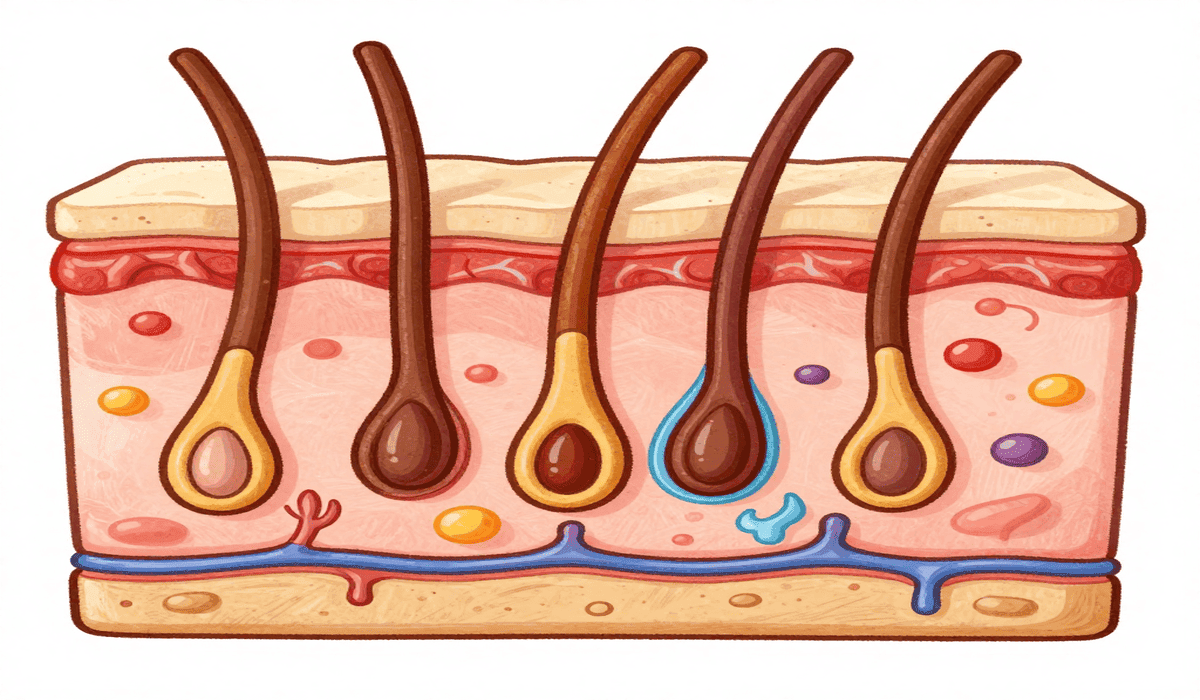
Hair Follicles: Grow from deep dermal invaginations. They consist of a bulb, hair shaft, and follicle wall to assist in protection and sensation.
Eccrine Sweat Glands: Distributed widely across the body; they secrete a watery sweat directly onto the skin surface to regulate body temperature.
Apocrine Sweat Glands: Located mostly in the groin and axillae (armpits), these glands emit a thicker, protein-rich fluid that, when broken down by surface bacteria, causes body odor.
Sebaceous Glands: Connected to hair follicles; they secrete sebum (oil) to lubricate, waterproof, and protect the skin from drying out.
Sensory Receptors
Meissner’s Corpuscles: Located in dermal papillae; detect light touch.
Pacinian corpuscles: Located deep in the dermis/hypodermis; respond to deep pressure and vibration.
Free Nerve Endings: Reach into the lower epidermis; sense temperature, pain, and itching.
Clinical Significance of Skin Histology
The study of histology for healthy skin is the ultimate bridge between laboratory science and real-world clinical practice:
Diagnostic Biopsies: Essential for identifying skin cancers, deep tissue infections, and inflammatory diseases (learn more about what to expect during a skin biopsy procedure).
Cosmetic Dermatology: Guides treatments like microneedling at home, laser resurfacing, and chemical peels by showing how the skin heals and rebuilds collagen.
Pharmaceutical Testing: Used to evaluate the safety, absorption, and efficacy of new skincare formulations.
Frequently Asked Questions (FAQ)
Q1. What are the three main layers of skin and their functions?
The three layers are the epidermis (outer protective barrier), the dermis (provides strength, nourishment, and elasticity), and the hypodermis (acts as an insulator and shock absorber).
Q2. How do melanocytes protect the skin from UV rays?
Melanocytes produce melanin, which is transferred to neighboring keratinocytes. Melanin forms a protective “umbrella” over the cell nuclei, absorbing harmful UV radiation and preventing DNA mutations.
Q3. Why are sebaceous glands important?
They secrete sebum, which naturally moisturizes the skin, prevents excessive water loss, and provides mild antibacterial defense.
Q4. Why is histology essential for the diagnosis of skin conditions?
Many skin diseases look identical on the surface. Microscopic examination of tissue samples allows pathologists to view cellular changes, giving an accurate diagnosis for conditions like psoriasis, eczema, and skin cancers.
Q5. What is the key difference between thick and thin skin?
Thick skin has a much thicker stratum corneum layer, lacks hair follicles and sebaceous glands, and is found only on the palms and soles. Thin skin covers the rest of the body and contains hair and oil glands.
Conclusion
Exploring histology for healthy skin offers a microscopic roadmap to understanding how our outer barrier maintains its beauty, strength, and protective features. From the cellular layers of the epidermis to the structural support of the dermis and hypodermis, every cell plays a vital role.
By analyzing these microscopic details, scientists and dermatologists can diagnose diseases with high precision, formulate superior skincare products, and help individuals preserve their skin’s vitality and radiance at every stage of life.
Disclaimer
The skincare advice, routines, and educational content in this article are provided for informational purposes only. Individual skin types react uniquely to active ingredients like vitamin C and retinol—knowing when to apply vitamin C serum is key to avoiding irritation. Always perform a patch test before trying new formulas, and consult a board-certified dermatologist for chronic skin concerns.