Copper Peptides vs. Vitamin C: Which is Best for Firming Aging Skin in 2026?
Copper Peptides vs. Vitamin C: The 2026 Guide to Firming Aging Skin
1. Introduction: The Battle for Collagen
In the high-stakes world of anti-aging skincare, collagen is the ultimate currency. It is the structural protein that acts as the “scaffolding” for your face, keeping your cheeks plump, your jawline snatched, and your forehead smooth. However, as we navigate the environmental stressors of 2026—from increased UV intensity to urban blue light—our skin is under constant siege. This has sparked a modern-day debate over Copper Peptides vs. Vitamin C to see which is more potent for the 2026 American consumer.
While both ingredients are often categorized under the broad umbrella of “antioxidants,” they serve two very different masters and operate with entirely different tactical strategies.
The Defensive Shield: Vitamin C
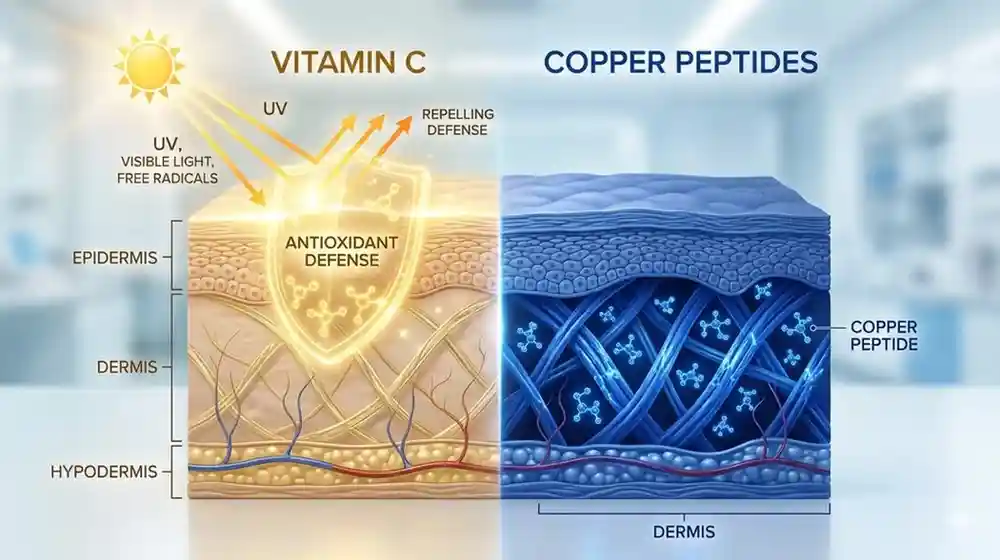
Think of Vitamin C (L-Ascorbic Acid) as your skin’s primary Defensive Player. Its main objective is protection. In the bustling environment of a typical American city, your skin is pelted with free radicals from pollution, car exhaust, and sun exposure. Vitamin C acts as a sacrificial shield; it neutralizes these “molecular scavengers” before they can reach your healthy skin cells and degrade your existing collagen. The “Security System” is what stops the harm from occurring in the first place.
Read: Our Full 2026 Guide to the Best Vitamin C Serums
The Offensive Strike: Copper Peptides
On the other side of the field, we have Copper Peptides (GHK-Cu), the ultimate Offensive Player. When comparing Copper Peptides vs. Vitamin C, copper is the one deep inside the “construction site” of your dermis, actively remodeling the skin.
Peptides don’t just protect; they signal. They are the “Project Managers” of the skin, sending direct messages to your fibroblasts to produce new collagen and elastin. More importantly, Copper Peptides have the unique ability to clear out damaged, “junk” collagen that has become stiff and brittle over time, replacing it with fresh, bouncy tissue.
Why the Distinction Matters in 2026
In previous years, we were told to just “buy a good serum.” In 2026, the savvy USA consumer knows that prevention (Defensive) and correction (Offensive) are two separate goals. If you are 25 and looking to stay young, your focus is defense. If you are 45 and looking to reverse the clock, you need a powerful offense.
Understanding the nuance of Copper Peptides vs. Vitamin C is the first step in moving beyond basic skincare and into the realm of Bio-Remodeling—a trend that is currently redefining the American beauty industry. In the sections that follow, we will break down why this offensive-defensive duo is the secret to a youthful complexion and how you can master the balance without causing irritation.
2. What are Copper Peptides (GHK-Cu)?
If you’ve spent any time on skincare forums or in a high-end beauty aisle lately, you’ve likely seen a striking, cobalt-blue serum that looks more like a laboratory experiment than a face lotion. In the debate of Copper Peptides vs. Vitamin C, that vibrant hue is a major differentiator. It isn’t a clever marketing dye; it is the natural signature of one of the most powerful restorative ingredients in modern science: Copper Peptides, specifically known as GHK-Cu.
The Science Simplified: The Skin’s “Messenger”
At its core, a peptide is simply a short chain of amino acids—the building blocks of proteins like collagen and elastin. A Copper Peptide is created when a specific peptide (GHK) attaches itself to a copper molecule.
Think of GHK-Cu as a biological “text message.” When comparing Copper Peptides vs. Vitamin C, it’s helpful to view copper as the “active repairman.” In our youth, our bodies naturally produce high levels of these messengers. When your skin is damaged or aging, these peptides travel to the site of the “problem” and signal your skin cells to fix themselves. They act like a project manager on a construction site, telling the fibroblasts to start producing new collagen and the immune system to clean up damaged tissue. As we hit our 40s and 50s, our natural supply of these “text messages” drops significantly, leading to the sagging skin we associate with aging.
The “Blue” Serum Phenomenon
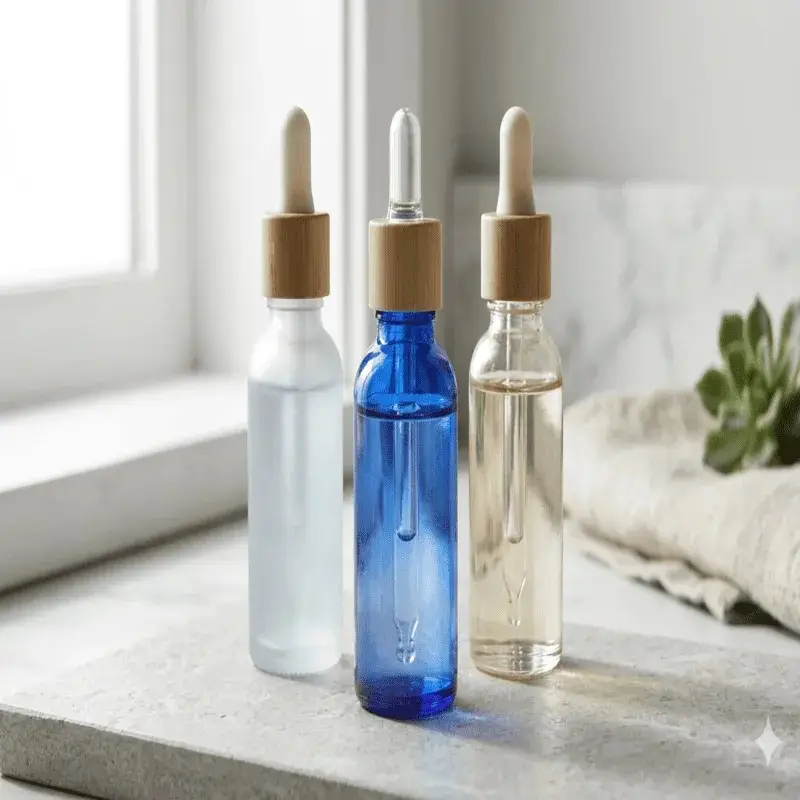
The most frequent question US dermatologists hear in 2026 is: “Why is my serum blue?” The answer lies in the chemistry of copper. When the GHK peptide binds with copper ions (), it creates a specific molecular structure that reflects light in the deep blue spectrum.
The Purity Test: In the USA market, the intensity of the blue color is a tell-tale sign of potency. A high-quality GHK-Cu serum should be a clear, vibrant sapphire.
The “Fairy Dust” Warning: If a product claims to win the Copper Peptides vs. Vitamin C battle but is milky, white, or clear, it likely contains “Copper Gluconate” or trace amounts that won’t deliver the same “bio-remodeling” results as pure GHK-Cu.
From Wound Care to Anti-Aging: The Healing Power
The rise of copper peptides in 2026 isn’t just a trend; it’s backed by decades of medical history. GHK-Cu was originally used in clinical wound care to accelerate the healing of post-surgical skin.
In the world of anti-aging, this “healing power” translates into dermal thickening. > Why this matters for aging skin: While Vitamin C focuses on the surface, Copper Peptides address the fact that as we age, the dermis becomes thin and transparent, leading to a “crepy” texture and visible veins.
By mimicking the body’s natural wound-healing response, Copper Peptides encourage the skin to thicken and densify. In 2026, clinical trials have shown that consistent use of GHK-Cu can increase skin thickness by up to 20%, providing a natural “filler” effect that smooths out fine lines from the inside out. In the structural fight of Copper Peptides vs. Vitamin C, copper is the ingredient that actually builds the skin back up.
3. Copper Peptides vs. Vitamin C: A Side-by-Side Comparison
When choosing between these two heavyweights, it helps to see them side-by-side. While both are essentials in a high-performance 2026 skincare routine, their “personalities” on the skin are vastly different. If you have struggled with the stinging sensation of traditional anti-aging products, this Copper Peptides vs. Vitamin C comparison highlights why Copper is becoming the go-to alternative for the sensitive-skin community in the USA.
Copper Peptides vs. Vitamin C: At a Glance
| Feature | Vitamin C (L-Ascorbic Acid) | Copper Peptides (GHK-Cu) |
| Primary Goal | Brightening & UV Protection: Acts as a shield against sun damage and fades dark spots. | Firming & Skin Remodeling: Acts as a builder to thicken skin and lift sagging areas. |
| Skin Type | Best for oily/resilient skin: Often requires a low pH that can be too harsh for dry types. | Best for sensitive/mature skin: Biomimetic nature means the skin recognizes and welcomes it. |
| Texture | Often tacky or oily: Pure L-Ascorbic Acid usually requires a propanediol or oil base. | Water-like and weightless: High-quality GHK-Cu serums absorb instantly without a film. |
| Stability | Highly unstable: Oxidizes (turns brown) when exposed to light, air, or heat. | Very stable: Maintains its potency for months and isn’t easily degraded by light. |
| Irritation Risk | High: Can cause stinging, redness, or “purging” in those with a compromised barrier. | Very Low: Naturally soothing and actually used to calm inflammation. |
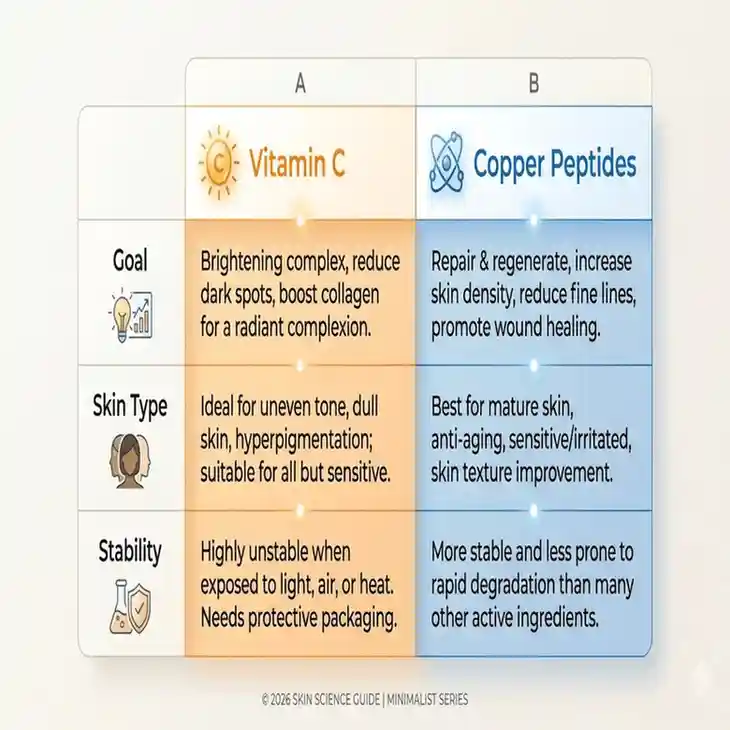
Understanding the Trade-Off
As you can see from the breakdown above, the Copper Peptides vs. Vitamin C choice often comes down to your individual Skin Tolerance versus your specific Skin Goals.
The Vitamin C User: You are likely in your 20s or 30s, live in a sunny or high-pollution environment (like LA or NYC), and your main concern is preventing future damage while keeping your skin tone even and glowing.
The Copper Peptide User: You are likely noticing “structural” changes—thinning skin under the eyes, loss of elasticity around the jawline, or “crepiness” on the neck. You need an ingredient that doesn’t just protect the surface but “remakes” the foundation.
Expert Tip for 2026: In the battle of Copper Peptides vs. Vitamin C, if you find that Vitamin C consistently makes your face red or itchy (a common complaint for those with Rosacea), swapping to a Copper Peptide serum provides the antioxidant benefits you need without the inflammatory “burn.” This shift allows you to maintain an anti-aging regimen without compromising your skin barrier.
Check out the Top Barrier Repair Creams for Sensitive Skin
4. Why Copper Peptides are Winning in 2026
The American skincare landscape has shifted dramatically over the last few years. While the early 2020s were defined by “slugging” and high-percentage acid peels, 2026 is the year of skin longevity. In the choice between Copper Peptides vs. Vitamin C, US consumers are no longer interested in stripping their skin for a temporary glow; they want density, resilience, and comfort.
Here is why Copper Peptides are currently outperforming traditional anti-aging ingredients in the quest for youthful skin.
The “Irritation Factor”: Ending Skincare Burnout
One of the most significant trends we’ve seen in 2026 is “Skincare Burnout.” After years of using high-strength Retinoids and 20% L-Ascorbic Acid, many women in the USA have ended up with chronically sensitized skin. When evaluating Copper Peptides vs. Vitamin C, it is important to note that Vitamin C requires a highly acidic environment ($pH < 3.5$) to penetrate the skin, which frequently causes stinging, redness, or the dreaded “purge.”
Conversely, Copper Peptides are biomimetic. This means your skin recognizes them as a natural component rather than a foreign irritant.
No Stinging: Unlike the sharp “bite” of Vitamin C, GHK-Cu is inherently anti-inflammatory.
No Downtime: You won’t experience the peeling or “retinol uglies,” making the Copper Peptides vs. Vitamin C debate an easy win for those with Rosacea, Eczema, or naturally thin, sensitive skin.
Structural Integrity: Rebuilding the “Basement”
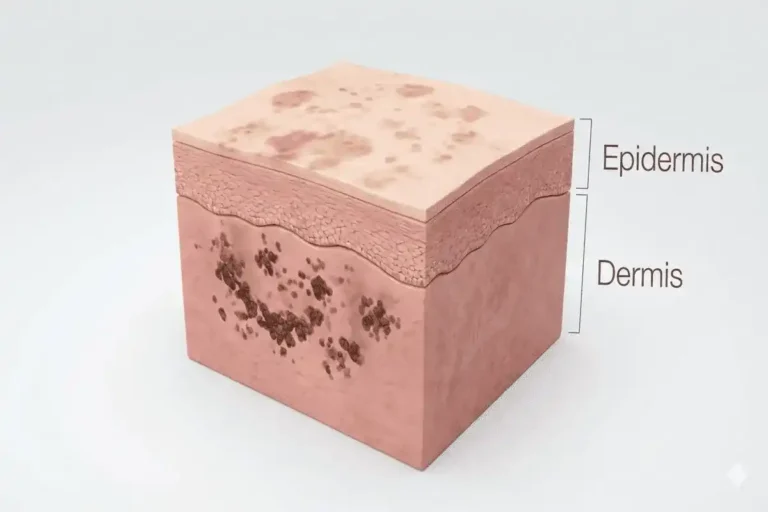
To understand why Copper Peptides are winning the battle against sagging, we have to look deeper than the surface. Most antioxidants, specifically in the Copper Peptides vs. Vitamin C comparison, serve different layers. Vitamin C does an excellent job of protecting the epidermis (the surface). However, aging—specifically sagging and “crepiness”—happens at the Dermal-Epidermal Junction (DEJ), often called the “basement membrane.”
As we age, this basement membrane flattens. Think of it like a mattress where the springs have snapped; the fabric on top (your skin) begins to fold and sag because there is no support underneath.
Targeted Remodeling: While Vitamin C brightens the surface, Copper Peptides are uniquely programmed to support the proteins that “anchor” the skin layers together.
Fixing “Crepy” Skin: Copper Peptides work to “re-spring” the mattress. This is why they are the 2026 gold standard for treating the thin, crinkled skin on the neck and under the eyes—areas where topical Vitamin C often fails to provide a visible lifting effect.
The 2026 “Slow Beauty” Movement
In the USA, the “Quick Fix” is being replaced by “Slow Beauty.” In the context of Copper Peptides vs. Vitamin C, peptides epitomize this movement. They don’t provide the instant, temporary tingle of an acid, but they offer cumulative structural improvement. By the 12-week mark, users typically report skin that feels “thicker” and “bouncier,” a result that Vitamin C simply cannot match on its own.
The Verdict for 2026: If your goal is to look better in a selfie today, use Vitamin C for the glow. If your goal is to have firmer, denser skin five years from now, the Copper Peptides vs. Vitamin C choice leans heavily toward Copper as your non-negotiable investment.
5. Can You Use Them Together? (The Golden Rule of Copper Peptides vs. Vitamin C)
If you are a skincare maximalist, your first instinct might be to layer both of these powerhouses to get the ultimate “glow-up.” However, in the world of 2026 cosmetic chemistry, there is one non-negotiable rule: Do not layer Vitamin C and Copper Peptides in the same application. In the structural battle of Copper Peptides vs. Vitamin C, they are incredible solo performers but chemically incompatible as a duo. Mixing them isn’t just a waste of money—it can actually work against your skin’s health.
The Conflict: Chemical Chelation
To understand the clash in the Copper Peptides vs. Vitamin C debate, we have to look at the pH levels of your products. Pure Vitamin C (L-Ascorbic Acid) is highly acidic, usually formulated at a pH of 2.5 to 3.5 to remain stable and penetrate the skin.
Copper Peptides, on the other hand, are highly delicate. When a high-concentration acid hits a copper peptide, a process called chelation occurs. The acid breaks the chemical bond between the peptide and the copper ion.
The Result: The copper is “stripped” away, leaving you with a basic peptide and free-floating copper.
The Waste: This renders both expensive serums virtually useless. Even worse, free copper on the surface of the skin can occasionally promote oxidation—the exact opposite of the “antioxidant protection” you were aiming for in your Copper Peptides vs. Vitamin C routine.
The 2026 Solution: Strategic Timing
You don’t have to choose a side in the Copper Peptides vs. Vitamin C rivalry for your overall lifestyle; you simply need to separate them by time. The most effective way to incorporate both into a USA-based skincare routine is the “AM Shield, PM Build” method.
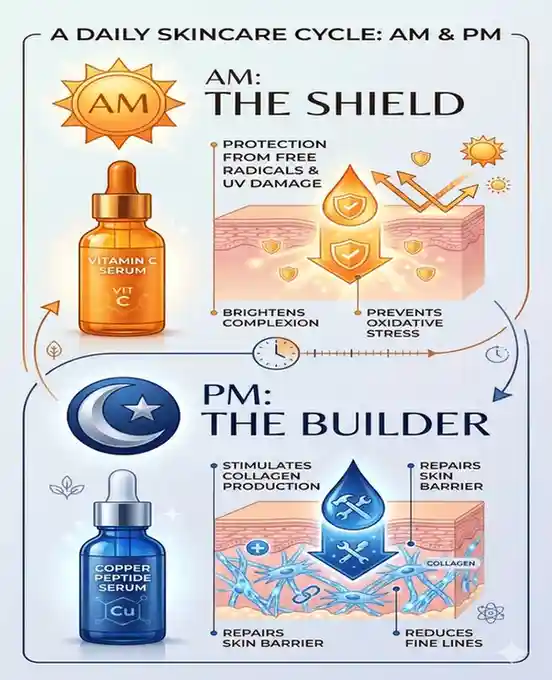
Morning (AM): The Vitamin C Shield
Apply your Vitamin C serum in the morning on clean, dry skin.
Why: Vitamin C’s primary job is to neutralize free radicals from UV rays and urban smog. By wearing it during the day, you are creating a secondary line of defense underneath your 2026 Sunscreen.
Evening (PM): The Copper Peptide Repair
Save your Copper Peptides for your nighttime routine.
Why: Your skin enters “repair mode” while you sleep. When comparing the nighttime benefits of Copper Peptides vs. Vitamin C, copper wins because it provides the “raw materials” and signaling cues your skin needs to perform deep structural remodeling without being interrupted by the sun.
The “15-Minute” Exception
If you absolutely must use both in the morning, wait at least 15 to 20 minutes between applications to allow your skin’s pH to neutralize. However, for 2026’s “minimalist layering” trend, keeping Copper Peptides vs. vitamin C in separate routines is widely considered the gold standard for maximum potency and skin density.
6. Top Copper Peptide Recommendations for 2026
The American skincare market in 2026 is flooded with peptide products, but not all are created equal. When deciding between copper peptides vs. vitamin C, the product you choose must have a high enough concentration of GHK-Cu to actually remodel the skin. Based on clinical efficacy, texture, and value, these are the top three serums currently leading the “Blue Wave” in the USA.
The Luxury Pick: NIOD Copper Amino Isolate Serum 3 1:1 (CAIS3)
Widely considered the “gold standard” by skincare purists, this is the third generation of NIOD’s award-winning formula. When we look at Copper Peptides vs. Vitamin C for textural repair, NIOD is the clear winner.
The Technology: It features a unique 1:1 ratio of GHK-Cu and free-form GHK peptides.
Why it’s worth it: Unlike most thick vitamin C serums, it has a water-like consistency that disappears into the skin instantly. It targets “textural irregularities”—meaning it’s excellent for those dealing with enlarged pores and loss of elasticity simultaneously.
Pro Tip: It comes with a separate activator; you mix it yourself to ensure the copper stays 100% fresh, solving the stability issues often found in the copper peptides vs. vitamin C debate.
The Best Value: The Ordinary Multi-Peptide + Copper Peptides 1%
Formerly known as “Buffet + Copper Peptides,” this remains the most accessible high-potency serum in the USA for 2026.
 🛒 Ready to Restore Your Skin’s Bounce?
Grab the dermatologist-recommended 2026 “Blue Serum” from the official Amazon store.
Check Price on Amazon: The Ordinary Copper Peptides 1%
As an Amazon Associate, I earn from qualifying purchases.
The Technology: It combines a 1% concentration of pure GHK-Cu with other heavy-hitting peptides like Matrixyl 3000 and Argireline.
Why it’s worth it: If you want one bottle that handles hydration, fine lines, and firming at an affordable price, this is the 2026 winner. In the context of Copper Peptides vs. Vitamin C, this serum provides a “comprehensive” approach, using multiple peptide chains to fix what Vitamin C cannot reach. It has a slightly thicker, gel-like texture compared to NIOD.
The Clean Beauty Choice: Biossance Squalane + Copper Peptide Rapid Plumping Serum
For those who prioritize “clean” clinical ingredients and instant gratification, this Biossance favorite is a top seller at US retailers like Sephora.
The Technology: It pairs copper tripeptide-1 with a “Rapid Plumping Complex” consisting of hyaluronic acid, polyglutamic acid, and sugarcane-derived squalane.
Why it’s worth it: It provides an immediate “flood” of moisture. When comparing Copper Peptides vs. Vitamin C for dry or mature skin, this serum wins on comfort. The squalane acts as a soothing barrier while the copper works on long-term firming—making it perfect for the dry, indoor heating common in US winters.
7. How to Spot a “Fake” Serum: Copper Peptides vs. Vitamin C Purity
As the debate of copper peptides vs. vitamin C has gone viral in 2026, the US market has seen a surge in “fairy-dusted” products. Many brands add just enough copper to claim the ingredient on the label, but not enough to actually remodel your skin. To ensure you aren’t wasting your skincare budget, here is how to be a savvy consumer when choosing between these two powerhouses.
1. Check the INCI List for authenticity.
When evaluating Copper Peptides vs. Vitamin C, the ingredient list (INCI) is your best friend. For a peptide serum to be effective, look for copper tripeptide-1 or Pre-shere GHK-Cu. These are the clinically studied forms that actually signal collagen remodeling.
The “Look-Alike” Trap: If the label says “Copper PCA” or “Copper Gluconate,” take note: these are different ingredients. While they offer antibacterial benefits (great for adult acne), they do not possess the structural anti-aging power of GHK-Cu. If your goal is firming, the Copper Peptides vs. Vitamin C choice only works if you are using the correct form of copper.
2. The Color Test: Sapphire vs. Clear
The physical appearance of your serum is a dead giveaway of its potency. In the chemistry of 2026 skincare, GHK-Cu is naturally a vibrant, deep cobalt blue.
The Sapphire Standard: A high-potency serum will have a clear, blue-ink appearance.
The Warning Sign: If a serum claims to be a “Copper Peptide Treatment” but is completely clear, white, or a very pale “ocean mist” color, it likely contains less than 0.01% of the active ingredient. In 2026, some brands even use artificial blue dyes (like Blue 1) to mimic the look. When comparing copper peptides vs. vitamin C, remember that pure vitamin C is clear (until it oxidizes), but pure copper peptides must be blue.
3. Packaging Matters for Stability
Stability is a major factor in the Copper Peptides vs. Vitamin C comparison. We know vitamin C is notoriously unstable and turns brown when exposed to air. While copper peptides are more stable, they are still sensitive to extreme, prolonged light exposure.
USA Premium Standards: Look for opaque pumps or dark amber glass. Avoid buying any “Blue Serum” sold in clear glass bottles sitting under bright retail lights in the USA, as this can degrade the signaling strength of the peptide over time.
Bottom Line: The Final Verdict on Copper Peptides vs. Vitamin C
Don’t pay “luxury” prices for a clear serum that lacks active signaling power. If you want the remodeling benefits that 2026 technology offers, look for the deep blue hue and check for Copper Tripeptide-1 on the back of the box.
When you master the timing—sticking to the “AM Vitamin C / PM Copper” routine—you effectively end the Copper Peptides vs. Vitamin C rivalry and let both ingredients work in harmony for the best skin of your life.
Frequently Asked Questions (FAQ): Copper Peptides vs. Vitamin C
Q: Can I use Copper Peptides with Retinol or Tretinoin?
A: This is a common concern for US users on prescription retinoids. In 2026, the consensus among dermatologists is that they can be used together, but it depends on your skin’s tolerance. In the context of copper peptides vs. vitamin C, copper is actually more compatible with retinol because it is healing and can help buffer the irritation of vitamin A. However, to avoid overwhelming your skin, many experts suggest “skin cycling”: use your retinol on Monday and your copper peptide serum on Tuesday.
Q: Will copper peptides make my skin turn blue like the serum?
A: No. While a high-quality serum is a vibrant sapphire blue, it is formulated to absorb completely. Once massaged in, it becomes transparent. If you see a blue tint left behind, you are likely using too much product—3 to 4 drops is usually sufficient. In the copper peptides vs. vitamin C comparison, remember that while vitamin C is clear, the blue hue of copper is your proof of potency.
Q: I use a vitamin C derivative (like sodium ascorbyl phosphate). Can I mix that with copper?
A: While derivatives are more stable and less acidic than pure L-ascorbic acid, we still recommend the “separation rule.” To ensure the copper ions don’t interfere with the antioxidant’s efficacy, it is best to keep the copper peptides vs. vitamin C derivatives in separate routines (AM vs. PM) to ensure you get the maximum collagen-building benefit from both.
Q: Is it possible to utilize copper peptides at home following microneedling?
A: Yes, GHK is among the limited active compounds that are genuinely beneficial following microneedling since it was formulated in wound-care facilities. When comparing copper peptides vs. vitamin C for post-procedure care, copper is the winner as it helps signal the skin to repair micro-channels more efficiently, whereas vitamin C might sting or irritate raw skin.
Q: How soon will I see a visible “lift” in my skin?
A: Unlike hyaluronic acid, which plumps the skin in minutes, copper peptides work on a cellular timeline. You may notice improved hydration and a “glow” within 7 days, but when looking at the long-term results of copper peptides vs. vitamin C, structural firming and the reduction of “crepey” skin typically take 8 to 12 weeks of consistent nightly use.
Disclaimer
The content of this article is meant exclusively for educational and informational use; it should not be viewed as medical advice. Skincare results can vary significantly based on individual skin type, genetics, and environmental factors. While copper peptides are generally considered low-irritation, always perform a patch test on a small area of skin before full application. If you have a known copper allergy or chronic skin condition like severe rosacea or eczema, consult with a board-certified dermatologist in the USA before introducing new active ingredients into your routine. This website may contain affiliate links to products we recommend; however, our reviews remain independent and based on 2026 clinical data and consumer feedback.