7 Best Chelating Shampoos for Hard Water & Mineral Buildup (2026 Guide)
The Best Chelating Shampoos for Hard Water & Mineral Buildup: 2026 Ultimate Guide
Does your hair feel like straw no matter how much conditioner you use? Is your expensive salon color turning brassy or orange after just two washes? If you live in the United States, you aren’t alone. According to the U.S. Geological Survey, approximately 85% of American homes have hard water.
While we focus heavily on skin barriers and serums, we often overlook the invisible enemy in our showerheads: minerals. Standard shampoos are designed to remove oils and dirt, but they are powerless against the “invisible rocks” clinging to your hair fibers.
In this guide, we dive deep into the science of chelating shampoos—the only real solution for hard water buildup—and how to restore your hair’s health, shine, and elasticity in 2026.
Executive Summary: Defeating Hard Water Hair
The core problem for most people isn’t their hair type, but mineral buildup. Hard water contains positively charged ions (Calcium, Magnesium, Copper, and Iron) that magnetically bond to the negatively charged hair shaft. This creates a “rock-like” coating that prevents moisture from entering, leading to the “Porosity Trap”—where hair becomes brittle, loses elasticity, and can even “cook” during chemical treatments.
The Solution: Chelation
Standard shampoos only remove oil and dirt. You need Chelating Shampoos (the “Molecular Claws”) to break the chemical bond between minerals and hair.
Top Recommended Products (2026)
Removes 88% of calcium buildup—perfect for restoring natural texture.
Neutralizes copper and iron inside the fiber to protect your salon color.
Decalcifies while restoring 99% of hair strength and original elasticity.
Uses micellar technology to lift minerals gently without stripping natural oils.
Effective high-potency formula for a deep clinical-grade clean at a lower price.
The “Reset” Protocol
- Dwell Time: Leave the shampoo on for 3-5 minutes to let the chelators work.
- Zoning: Focus on the mid-lengths and ends where buildup is oldest.
- The Squeaky Test: Ensure hair feels naked and clean.
- pH Restoration: Always follow with an acidic conditioner to seal the cuticle.
Bottom Line: To restore shine and prevent breakage, use a chelating shampoo every 7–10 days. This removes the physical barrier, allowing your expensive treatments and conditioners to finally work.
1. The Invisible Science of Hard Water
Hard water is defined by a high concentration of dissolved minerals, primarily calcium and magnesium, but often containing iron, copper, and manganese. In the United States, geography plays a massive role in your hair health; states like Arizona, Texas, and Florida are notorious for “liquid rock” flowing through the pipes.
When you wash your hair, these minerals react with the fatty acids in your shampoo to create “soap scum” (technically known as calcium stearate). This film doesn’t just sit on top of your hair; it undergoes a process of mineralization, where it crystallizes inside the hair cuticle. Over time, this buildup acts as a physical barrier—a “mineral wall”—preventing moisture, oils, and expensive salon treatments from entering the hair shaft.
The “Hard Water Hair” Syndrome
If you are struggling with your hair’s appearance, you are likely experiencing “Hard Water Hair,” characterized by:
Extreme Dryness and Brittleness: The mineral coating prevents the hair from absorbing water, leading to a “straw-like” texture.
Lack of Volume: Minerals are heavy. They weigh down the hair at the root, making even the thickest hair look limp and flat.
The “Brassy” Shift: Copper and iron in water can oxidize, turning blonde hair orange or greenish and making dark hair look muddy.
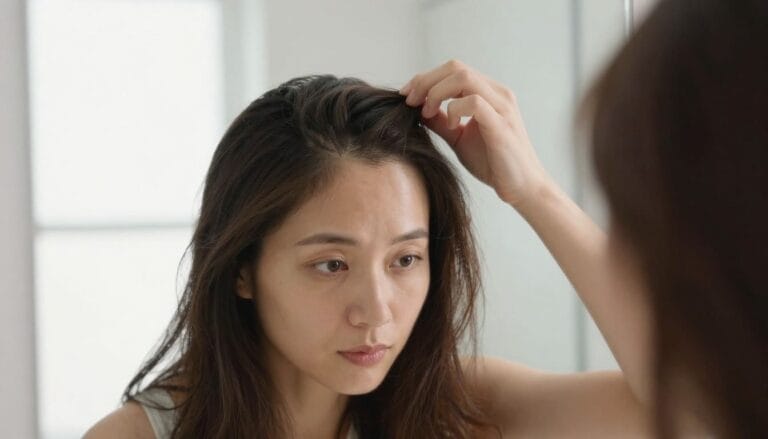
Persistent Itchy Scalp: Mineral crystals can irritate the scalp, mimicking the appearance of dandruff but resisting traditional anti-dandruff treatments.
How Chelation Actually Works
This is where the best chelating shampoos for hard water become a scientific necessity. The term “chelate” is derived from the Greek word chele, meaning “claw.”
Unlike regular surfactant molecules that simply surround oil and dirt to wash them away, chelating agents are sophisticated ligands. These molecules wrap around metallic ions (like calcium and magnesium) and create a stable, water-soluble complex. Essentially, they “claw” the mineral out of its crystallized state inside your hair cuticle and hold it in suspension so that it cannot re-deposit on your strands during the rinse cycle.
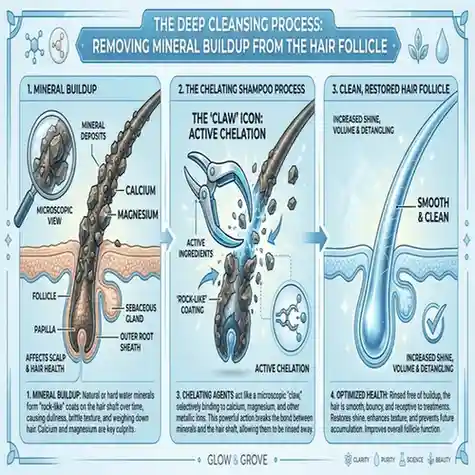
Without this “claw” action, the minerals remain bonded to your hair’s protein structure, leading to long-term cumulative damage. By using a chelating formula, you are essentially performing a “chemical detox” that resets your hair to its natural, porous, and healthy state.
2. Why Regular Shampoo Isn’t Enough
To extend this section, you should explain the “Ion Exchange” that happens in the shower…
Most standard shampoos sold in USA drugstores use simple surfactants like Sodium Lauryl Sulfate (SLS). While SLS is great at stripping away the natural oils (sebum) and styling products, it is chemically incapable of breaking the ionic bond between a mineral and the hair shaft.
In fact, using a high-sulfate regular shampoo with hard water can actually make the problem worse. The sulfates react with the calcium in the water to create even more soap scum, which sticks to your hair like glue. This is why your hair often feels “tangled” or “rough” even while you are still in the shower. To truly clean the hair, you must move beyond surface-level cleansing and utilize the ionic technology found only in the best chelating shampoos for hard water.
2. Why Regular Shampoo Isn’t Enough for Hard Water
“Can’t I just use a clarifying shampoo?” may be on your mind. The answer is usually no. While it’s a common misconception in the beauty world, regular deep-cleansing shampoos are physically incapable of removing the heavy metal ions found in American tap water. To understand why you need the best chelating shampoos for hard water, you have to look at the difference between “organic” and “inorganic” buildup.
Clarifying vs. Chelating: The Critical Difference
Most people confuse these two, but they serve entirely different purposes in a hair care science:
Clarifying Shampoos (The Organic Cleanse): These are high-detergent cleansers, often formulated with strong sulfates. They are excellent at removing organic buildup—things like dry shampoo, heavy silicones, styling waxes, hairspray, and excess sebum (oil). Think of clarifying as a “deep scrub” for the surface. However, they lack the chemical “claws” to break the ionic bond between minerals and the hair protein.
Chelating Shampoos (The Inorganic Detox): These are specialized medical-grade or professional-grade formulas. They contain sequestering agents that target inorganic matter (minerals, heavy metals, and chlorine). If you have green-tinted hair from a swimming pool or “rust-tinted” hair from a house with old copper pipes, a clarifying shampoo will do nothing. Only the best chelating shampoos for hard water can de-mineralize the hair fiber.
The Science of the “Ionic Bond”
Why won’t regular soap work? Minerals like calcium and magnesium carry a positive charge (+). Your hair, especially if it is damaged or porous, carries a negative charge (-). Because opposites attract, these minerals act like tiny magnets, snapping onto your hair shaft and refusing to let go.
A regular shampoo simply slides over these “magnets.” A chelating shampoo, however, introduces a stronger attraction. The chelating agents (like EDTA) surround the mineral ion, neutralizing its charge and lifting it away from the hair so it can be rinsed down the drain.
The “Wall” Effect and Product Wastage
Using a regular shampoo on hard water buildup is like trying to paint a wall that is covered in thick dust and grease—the paint simply won’t stick. In the hair world, this buildup creates a “mineral wall.”
Without the best chelating shampoos for hard water, your expensive $50 hair masks, bond-builders (like Olaplex), and hydrating conditioners are literally going down the drain. They cannot penetrate the mineral wall to reach the inner cortex of your hair. This leads to a frustrating cycle: you buy more expensive products to fix your dry hair, but the products can’t work because the minerals are blocking the way.
The Hidden Danger of “Soap Scum”
In many USA households, the “squeaky” feeling you get after washing isn’t actually cleanliness—it’s the feeling of calcium soap curd. When the minerals in hard water meet the fatty acids in standard shampoo, they create a waxy precipitate. This “scum” clogs the pores of your scalp and coats the hair, leading to “oxidative stress.” This stress weakens the hair’s disulfide bonds, making your hair more prone to snapping when you brush it. By using the best chelating shampoos for hard water, you dissolve this wax and allow your hair to breathe again.
3. The Best Shampoo Ingredients: What to Look For
When shopping for a hard water solution in 2026, don’t be fooled by “natural” labels that offer no scientific backing. To find the best chelating shampoos for hard water, you must become an “ingredient detective.” Flip the bottle over and look at the INCI (International Nomenclature Cosmetic Ingredient) list.
If you don’t see the following scientifically proven sequestering agents, the shampoo is likely just a basic cleanser that won’t solve your mineral problems.
The Industry Gold Standards for Disodium and Tetrasodium EDTA
These are the most common and arguably the most powerful chelating agents found in the best chelating shampoos for hard water.
Disodium EDTA is excellent for maintaining product stability and grabbing light mineral deposits.
Tetrasodium EDTA is the heavy hitter; it is particularly powerful in alkaline environments (which is exactly what hard water is).
These ingredients work by creating a “molecular cage” around calcium and magnesium ions. Once the mineral is trapped inside this cage, it loses its ability to stick to your hair protein, allowing it to be flushed away during the rinse.
Sodium Phytate: The 2026 Clean Beauty Alternative
As the USA market moves toward more sustainable and biodegradable options, Sodium Phytate has emerged as a superstar ingredient. Derived from rice bran or corn, this is a completely natural, plant-based chelator. In the best chelating shampoos for hard water that carry “Clean at Sephora” or “Eco-friendly” labels, Sodium Phytate provides a powerful negative charge that attracts positively charged metal ions. It is highly effective at neutralizing copper and iron, making it a favorite for those who want to avoid synthetic chemicals without sacrificing performance.
Vitamin C (Ascorbic Acid): The “Rust” & Chlorine Neutralizer
If you’ve ever noticed your blonde hair turning orange (iron buildup) or green (copper/chlorine buildup), Vitamin C is your best friend. Frequently the star ingredient in professional treatments like Malibu C, Vitamin C acts as a reducing agent. It breaks the oxidative bond that minerals form with the hair. For swimmers or those with old well-water pipes, Vitamin C is a non-negotiable ingredient in the best chelating shampoos for hard water because it physically dissolves the “rust” stains that other shampoos leave behind.
Gluconolactone: The Multi-Tasking PHA
A newcomer to the “Best Chelating Shampoos for Hard Water” list in 2026 is Gluconolactone, a Polyhydroxy Acid (PHA). This ingredient offers a triple-threat benefit:
Chelation: It has multiple hydroxyl groups that bind to metal ions.
Scalp Health: As a gentle acid, it dissolves the “mineral crust” on your scalp that can cause itching and flaking.
Hydration: Unlike harsh sulfates, Gluconolactone is a humectant, meaning it draws moisture into the hair while it cleanses.
Citric Acid: The pH Balancer
While often used in small amounts to balance pH, in higher concentrations, Citric Acid acts as a secondary chelator. Hard water is naturally alkaline (high pH), which causes the hair cuticle to stand up and feel rough. The best chelating shampoos for hard water use Citric Acid to bring the hair back to its optimal acidic pH (between 4.5 and 5.5), which flattens the cuticle and restores instant shine.
Pentasodium Pentetate
Often found in professional-only formulas, this is one of the strongest chelators available. It is specifically used in the best chelating shampoos for hard water designed for “extreme buildup” cases. It can remove heavy metal salts that have been stuck in the hair for years, making it the “nuclear option” for hair restoration.
4. The Best Chelating Shampoos for Hard Water: Top 2026 Picks
Based on clinical performance, ingredient purity, and verified user feedback, these are the best chelating shampoos for hard water currently dominating the USA market. Whether you are dealing with “city water” in New York or “well water” in Texas, there is a specific formula for your hair type.
1. Malibu C Hard Water Wellness Shampoo
The “Gold Standard” for Hard Water This is widely considered the overall best chelating shampoo for hard water on the market today. Unlike multi-purpose shampoos, Malibu C was built specifically for this one problem.
Why it works: It uses a patented blend of Vitamin C (Ascorbic Acid) and EDTA to physically dissolve mineral crystals.
Best for: People living in the “Hard Water Belt” (Midwest and Southwest USA). It is a lifesaver for those with well water who deal with iron and calcium daily.
The Result: It immediately eliminates the “crunchy” or “tangled” feeling hair gets after a shower, leaving it surprisingly soft and manageable.
2. OUAI Detox Shampoo
The Luxury “City Water” Solution If you want your hair to smell like a high-end spa while you strip away heavy metals, this is the best chelating shampoo for hard water for you.
Why it works: It combines Apple Cider Vinegar (ACV) for surface shine and pH balancing with a powerful chelating complex to remove deep mineral deposits.
Best for: City dwellers (NYC, Chicago, LA) who deal with old copper pipes and high chlorine levels. It’s also excellent for removing heavy styling products like waxes and dry shampoos.
The Result: High-gloss, “squeaky clean” hair that feels weightless and smells like OUAI’s signature Melrose Place fragrance.
3. K18 PEPTIDE PREP™ Detox Shampoo
The Greatest for Color-Treated and Damaged Hair You should use caution if bleaching or heat styling has made your hair brittle. K18 offers the best chelating shampoo for hard water that doesn’t compromise hair strength.
Why it works: It is clinically proven to remove 99% of product buildup and 76% of copper buildup in just one wash. It uses a patented K18 Peptide to protect the hair’s keratin while the chelators do the heavy lifting.
Best for: Anyone using “bond-builders” or those with high-porosity hair that sucks up minerals like a sponge.
The Result: A clean canvas that allows your repair treatments (like K18 or Olaplex) to actually penetrate the hair shaft.
4. Living Proof Triple Detox Shampoo
The Gentle Choice for Sensitive Scalps Many deep-cleansing shampoos can cause irritation, but Living Proof has created one of the best chelating shampoos for hard water for sensitive skin.
Why it works: It uses a sulfate-free surfactant system combined with Sodium Phytate (a natural chelator) and Activated Charcoal to suck out impurities without stripping the scalp’s natural moisture barrier.
Best for: People with eczema, psoriasis, or a naturally dry scalp who still need to remove mineral buildup.
The Result: A refreshed scalp and hair that feels clean but not “stripped” or tight.
5. Kenra Brightening Shampoo
The Best for Blondes, Silver, and Highlights Hard water is the #1 enemy of blonde hair, often turning it a dull, muddy yellow. Kenra is the best chelating shampoo for hard water specifically formulated to brighten light hair.
Why it works: It contains an advanced chelating complex that targets the specific metals (like manganese and iron) that cause color shifting.
Best for: Platinum blondes, grey-haired individuals, or those with expensive balayage who want to keep their “cool” tones.
The Result: It instantly removes the “dingy” look, restoring the bright, vibrant tone you had when you walked out of the salon.
6. Ion Hard Water Shampoo (The Budget Favorite)
For those looking for an affordable yet effective option at Sally Beauty, this is a staple. It provides the essential EDTA “claw” action at a fraction of the price of luxury brands, making it one of the best chelating shampoos for hard water for students or budget-conscious shoppers. It is simple, effective, and gets the job done without the fancy marketing.
5. How to Use Hard Water Shampoos Correctly
To get the best results from the best chelating shampoos for hard water, you have to treat the process like a professional salon treatment rather than a quick morning scrub. Because these formulas are “active”—meaning they are chemically designed to break molecular bonds—using them incorrectly can lead to either wasted product or overly dry hair.
Follow this expert-approved protocol to ensure you are getting the full de-mineralizing power of your shampoo:
1. Saturate Thoroughly with Warm Water
Before applying the product, ensure your hair is completely saturated. Use warm water (not scalding hot). The warmth helps to slightly swell the hair shaft and lift the cuticle scales. This is a crucial step because the minerals aren’t just sitting on top of your hair; they are tucked under the cuticle. For the best chelating shampoos for hard water to work, they need that “open door” to reach the mineral crystals hidden inside.
2. Strategic Application: Scalp vs. Lengths
Most people are taught to only shampoo the scalp. However, when using the best chelating shampoos for hard water, you must break this rule. While you should massage the scalp to remove “mineral crust,” you must also work the lather through the entire length of the hair, all the way to the ends.
The ends of your hair are older and more porous, meaning they have had more time (sometimes years) to soak up calcium and copper.
If you only wash the scalp, the mid-lengths and ends will remain brittle and prone to snapping.
3. The “Wait” Rule (The Most Important Step)
This is where most people fail. Chemical processes take time, and chelation is one of them. Most of the best chelating shampoos for hard water require a “dwell time” of 3 to 5 minutes.
If you rinse immediately, the EDTA or Sodium Phytate won’t have enough time to “claw” onto the minerals.
Pro Tip: Apply the shampoo, then use that time to wash your body or exfoliate. If your buildup is extreme (e.g., your hair is literally orange from iron), you can leave it on for up to 10 minutes under a shower cap.
4. Rinse with Cooler Water
After the chelating agents have successfully trapped the minerals, rinse them away. However, for the final 30 seconds of your rinse, turn the temperature down. Cooler water helps to “reset” the hair cuticle, laying it flat against the shaft. This creates an immediate increase in shine and smoothness that you won’t get with a hot rinse.
5. Follow with a Deep Moisture Treatment
When the best chelating shampoos for hard water remove the mineral “wall,” they leave your hair completely “naked.” The protective film (and some natural oils) are gone. This is the perfect time to apply a high-quality hair mask or deep conditioner.
Because the mineral barrier is gone, your hair will absorb moisture like a sponge.
Look for masks containing ceramides or lipids to replenish the hair’s internal structure. This “Cleanse + Replenish” combo is the secret to that “just left the salon” feel.
6. Frequency: Finding Your “Sweet Spot”
How often should you use the best chelating shampoos for hard water? It depends on your water’s hardness level:
Moderate Hard Water: Once every two weeks.
Extreme Hard Water / Well Water: Once a week.
Swimmers: After every heavy pool session. Using it more than twice a week is usually unnecessary and can lead to over-stripping the hair’s natural moisture.
6. Common Mistakes to Avoid with the Best Chelating Shampoos for Hard Water
Even the best chelating shampoos for hard water can cause issues if used improperly. Because these are highly functional, “high-tech” products, they require a different approach than your average drugstore cleanser. Avoid these four common pitfalls to keep your hair healthy:
Over-Cleansing: The “Too Much of a Good Thing” Rule
The most common mistake is using these shampoos daily. Unless you are a professional swimmer spending hours in a chlorinated pool every day, you should not use the best chelating shampoos for hard water more than once a week. Over-chelating can strip away the essential lipids and fatty acids that keep your hair elastic. If you overdo it, your hair may become “over-sensitized,” feeling gummy when wet and brittle when dry. For most USA households, a “Sunday Reset” wash is the perfect frequency.
Skipping the Post-Chelation Condition
Chelating is essentially a “deep detox” for your hair. It removes everything—the bad minerals, but also some of the good natural oils (sebum). If you don’t follow up with a high-quality conditioner, your hair will be prone to extreme tangling and static. After using the best chelating shampoos for hard water, your hair’s “receptors” are wide open. This is the absolute best time to use a bond-builder or a deep moisture mask, as the product can finally penetrate the hair shaft without a mineral barrier blocking the way.
Using on Freshly Colored Hair
If you just spent $300 on a professional balayage or a vivid color service, wait. You should avoid even the best chelating shampoos for hard water for at least 72 hours (or 3–4 regular washes) after your appointment. Fresh hair color needs time to “settle” into the hair cortex. Because chelating agents are designed to lift heavy metals (and some hair dyes use metallic bases), using a chelator too soon can cause your expensive color to fade or shift tones prematurely.
Ignoring the Scalp Health
Many people focus only on the hair strands, but minerals like calcium and magnesium also settle on the skin. This creates a “mineral crust” on the scalp that can block hair follicles and cause “cradle cap” symptoms in adults—itchy, flaky, and inflamed skin. When applying the best chelating shampoos for hard water, give yourself a gentle 2-minute scalp massage. This breaks up the mineral deposits on the skin, preventing “hard water dandruff” and promoting a healthier environment for hair growth.
7. Additional Tips for Managing Hard Water Beyond Shampoo
While the best chelating shampoos for hard water are your strongest weapon, managing mineral buildup is easier when you take a multi-angled approach. Here’s how to address the issue at its root:
Invest in a High-Quality Showerhead Filter
In the USA, brands like Jolie and AquaBliss have become viral sensations for a reason. It is important to note: a shower filter does not “soften” water (only a massive salt-based whole-house system can do that). However, a good filter removes chlorine, lead, and heavy sediments before they hit your head. By reducing the chemical load on your hair, your best chelating shampoos for hard water won’t have to work as hard, allowing you to use them less frequently.
The Power of the Apple Cider Vinegar (ACV) Rinse
As we discussed in our Apple Cider Vinegar Scalp Guide, acidity is the enemy of mineral buildup. Hard water is alkaline (high pH), which keeps the hair cuticle open and rough. An ACV rinse after using one of the best chelating shampoos for hard water helps to immediately snap the cuticle shut. This makes the hair surface so smooth that new minerals have a much harder time “grabbing” onto the hair fiber in your next shower.
The “Distilled Water” Final Rinse
If you live in an area with extreme hard water (like Las Vegas or parts of Florida), try the Gallon Rinse Method. Keep a gallon of distilled water (which has zero mineral content) in your bathroom. After your final shower rinse, pour the distilled water over your hair. This ensures that as your hair dries, it isn’t “evaporating” and leaving behind a fresh layer of calcium and magnesium on your strands. This one simple step can double the effectiveness of the best chelating shampoos for hard water.
Use Leave-In Chelators
In 2026, we are seeing a rise in “leave-in” mineral shields. After washing with the best chelating shampoos for hard water, apply a leave-in spray that contains a small amount of Sodium Phytate. This acts as an “invisible shield,” neutralizing minerals in the water the next time you wet your hair, providing 24/7 protection against buildup.
Frequently Asked Questions (FAQs) about the Best Chelating Shampoos for Hard Water
Q: Will the best chelating shampoos for hard water ruin my keratin treatment?
A: This is a common concern in the USA. Most traditional chelating shampoos use strong sulfates (like SLS) to assist the chelating agents, which can indeed strip a keratin treatment or a Brazilian Blowout. If you have a professional smoothing treatment, you must look for Sulfate-Free options among the best chelating shampoos for hard water, such as the K18 PEPTIDE PREP™ or the Living Proof Triple Detox. These will remove the minerals without dissolving the keratin bond.
Q: Can I use the best chelating shampoos for hard water on my kids?
A: Yes, especially if your children are on a swim team or if your home uses well water. Children’s hair is often finer and more “virgin” (unprocessed), meaning minerals can actually weigh it down even faster. However, since their scalps are more sensitive, only use a chelating treatment once every two to three weeks and stick to “Clean Beauty” formulas that use Sodium Phytate instead of harsh synthetic EDTA.
Q: My hair feels “squeaky” or “rubbery” after using it. Is that bad?
A: That “squeaky clean” sensation is the physical absence of the mineral film and silicone buildup. While it feels strange compared to the “silky” feeling of coated hair, it is actually a sign that the best chelating shampoos for hard water have done their job. It’s not “bad,” but it is a signal that your hair is currently “open” and vulnerable. You must apply a high-quality conditioner or mask immediately to reseal the cuticle.
Q: Is permanent hair loss possible with hard water?
A: Hard water does not typically cause androgenetic alopecia (pattern baldness) because it doesn’t affect the hair follicle deep under the skin. However, it causes severe breakage. The mineral buildup makes the hair so brittle that it snaps off near the root during brushing or even while sleeping. This creates the appearance of thinning hair. By using the best chelating shampoos for hard water, you restore elasticity, which stops the breakage and allows your hair to grow to its full potential length.
Q: Can I just use Apple Cider Vinegar instead of a chelating shampoo?
A: ACV is a fantastic pH balancer and helps remove very light surface “scum,” but it is not a true chelator. It doesn’t have the chemical “claws” needed to pull heavy minerals like iron or copper out of the hair shaft. For a complete detox, use the best chelating shampoos for hard water first, then use an ACV rinse as a final step to lock in the shine.
Q: How do I know if my area in the USA has hard water?
A: You can look for “white crusty buildup” on your faucets or “spots” on your glassware after washing. Alternatively, states like New Mexico, Kansas, Arizona, and Ohio have some of the hardest water in the country. If you live in these areas, owning the best chelating shampoos for hard water isn’t a luxury—it’s a necessity for hair maintenance.
Final Thoughts: Restoring Your Hair in 2026
Living with hard water is a reality for over 85% of Americans, but it doesn’t have to mean living with “bad hair days” forever. We often blame our genetics or our aging process for hair that feels dry and lifeless, when the culprit is simply the water coming out of our showerheads.
By incorporating the best chelating shampoos for hard water into your routine just once a week, you are performing a vital “chemical reset.” This process removes the invisible mineral barrier, allowing your expensive serums, oils, and masks to finally do their job. You’ll find that your hair color stays vibrant for weeks longer, your curls regain their natural bounce, and your hair finally feels like hair again, rather than straw.
The Bottom Line: If you haven’t de-mineralized your hair in the last month, your hair is likely “suffocating” under a layer of calcium and magnesium. Choose one of the best chelating shampoos for hard water from our 2026 list, follow the “3-minute wait” rule, and witness the instant transformation of your hair’s health and shine.
Disclaimer
Medical Advice Disclaimer: The information provided in this article, including text, graphics, and images, is for educational and informational purposes only. While we focus on the best chelating shampoos for hard water, this content is not intended to be a substitute for professional medical advice, diagnosis, or treatment.
Results May Vary: Hair health and reactions to specific ingredients can vary significantly based on individual hair types, scalp conditions, and the specific mineral content of your local water supply. Always perform a patch test before using a new chelating or clarifying product, especially if you have a sensitive scalp or existing skin conditions like eczema or psoriasis.
Consult a Professional: Always seek the advice of your dermatologist, trichologist, or a licensed hair care professional with any questions you may have regarding a medical condition or severe hair loss. Never disregard professional advice or delay seeking it because of something you have read on Nagash Health.
Affiliate Disclosure: This post may contain affiliate links. If you purchase through these links, we may earn a small commission at no additional cost to you, which helps us continue to provide high-quality, science-backed content for our readers.