When to Apply Vitamin C Serum: Morning vs. Night (2026 Guide)
Vitamin C Serum Use: Morning vs. Night (2026 Guide)
You bought the orange bottle. On social media, you came across the “before and after” pictures. You’re ready for that high-definition glow that makes people ask if you’ve just come back from a tropical vacation. But then, you hit a wall. You’re standing in your bathroom at 7:00 AM, looking at your Vitamin C serum, then at your sunscreen, then at your clock.
“Wait, would it hurt if I go outside in the sun? A voice in your head queries. Or should I save this for my bedtime routine so it can work while I sleep?”
If you’re confused about when to apply vitamin C serum, you aren’t alone. It is one of the most searched skincare queries in 2026. If you get the timing wrong, you’re either wasting expensive product or, worse, irritating your skin barrier. Get it right, and you unlock a level of brightness that no filter can replicate. Let’s settle this debate using the PAS (Problem-Agitation-Solution) framework to see exactly where your serum belongs.
The “Expensive Glow” That Never Occurs is the Issue
Most people treat Vitamin C like a magic potion. They apply it randomly—sometimes in the morning, sometimes at night, sometimes skipping three days because they aren’t sure when to apply vitamin C serum for the best results.
The problem is that vitamin C (specifically L-ascorbic acid) is a notoriously “picky” molecule. It is unstable, it oxidizes when it sees the light, and it has a specific saturation point. If you apply it at the wrong time, it doesn’t just “work less”—it might not work at all. Many users report that their serum turns brown in the bottle before they’ve even seen a difference in their dark spots. Without a strategic timing plan, you’re essentially pouring your investment down the drain.
Advertisement
Don’t let your serum go to waste!
The Agitation: The Invisible Damage You Can’t See (Yet)
While you’re debating when to apply vitamin C serum, environmental stressors are actively attacking your skin cells. Every time you step outside, UV rays and urban pollution trigger free radicals. These unstable oxygen molecules act like tiny “skin-cell thieves,” stealing electrons from your healthy collagen.
If you only apply vitamin C at night, your skin is “naked” during the day when the attack is most aggressive. You are caught in a cycle of trying to repair damage that you could have prevented in the first place.
The Science of When to Apply Vitamin C Serum for Maximum Results
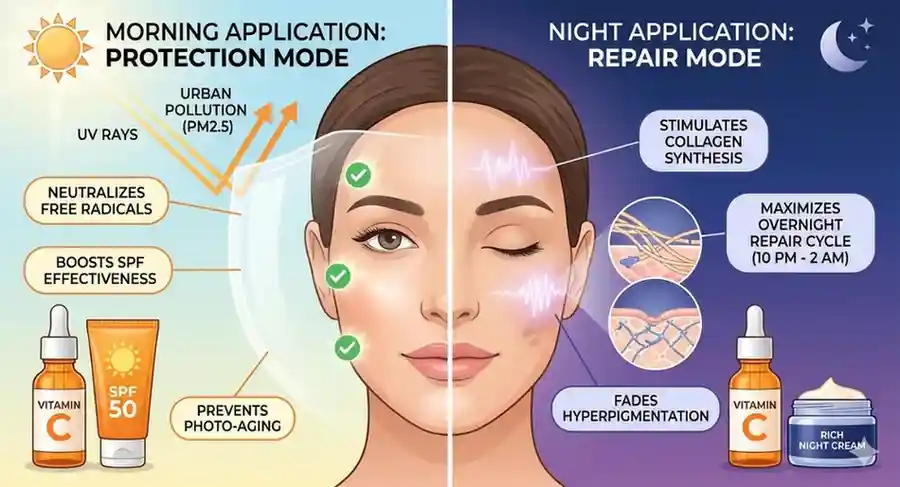
To maximize your results, you need to align your application with your skin’s natural circadian rhythm. In 2026, the clinical consensus remains firm: morning is the gold standard. When you apply vitamin C in the morning, you are creating a biological shield.
Recommended for You
The Sunscreen Synergy
Sunscreen is your first line of defense, but it isn’t perfect. Even a high-quality SPF 50 only blocks about 98% of UVB rays.
Data Point: Clinical studies show that a combination of 15% Vitamin C and 1% Vitamin E increases sunscreen effectiveness by a factor of four.
The Result: Vitamin C cleans up the free radicals that “leak” through your sunscreen barrier.
The Urban Protection Factor
If you live in a city, you are exposed to smog and heavy metals. These particles sit on the skin and cause inflammation. Morning Vitamin C acts as a sacrificial layer; the pollution attacks the Vitamin C molecules instead of your skin cells. This is a primary reason why experts suggest the morning as the best time for when to apply vitamin C serum.
The Case for Night: When to Apply Vitamin C Serum for Repair
While morning is for protection, the night is for recovery.
1. Collagen Synthesis & Cell Mitosis
Your skin’s rate of repair peaks between 10:00 PM and 2:00 AM. This is when cell mitosis is at its highest. A necessary cofactorl for the synthesis of collagen is vitamin C. Applying it at night ensures a high concentration of the nutrient is available exactly when the “repair crew” starts their shift.
2. Managing Skin Sensitivity
Pure L-ascorbic acid has a low pH (around 3.5), which can be irritating. For those with reactive skin, the night is the safest answer for when to apply vitamin C serum. It removes the risk of sun-induced irritation and allows the serum to sink in for 8 hours undisturbed by sweat or makeup.
Deep Dive: Derivatives and When to Apply Vitamin C Serum
Not all vitamin C is created equal. The specific type of vitamin C you use may change the answer to when to apply vitamin C serum.
L-Ascorbic Acid (Pure Vitamin C)
This is the most potent but least stable form. Because it is highly reactive with UV light, it is best used in the morning alongside a strong SPF. If your bottle is clear or the serum is turning yellow, it has oxidized and may actually cause free radical damage rather than preventing it.
Sodium Ascorbyl Phosphate (SAP)
SAP is a stable, water-soluble derivative that is particularly effective for acne-prone skin. It has a higher pH than pure vitamin C, making it gentler. You can choose when to apply vitamin C serum of this type based on your acne medication schedule—usually, the morning is best to fight bacteria.
Tetrahexyldecyl Ascorbate (THD Ascorbate)
THD penetrates the skin more deeply and is soluble in oil. Because it is much more stable and “creamy” in texture, many dermatologists recommend using it at night as a luxury treatment for deep-set wrinkles and hyperpigmentation.
Lifestyle Factors: Customizing When to Apply Vitamin C Serum
Your daily routine should dictate your timing. Here is a guide based on 2026 lifestyle trends:
The Outdoor Athlete: If you run or bike in the morning, apply your serum after your post-workout shower. Sweat can wash away the serum before it absorbs.
The Night Owl: If you stay up late under blue light (screens), apply your vitamin C at night. Blue light also generates oxidative stress, and vitamin C can help mitigate this “tech-aging.”
The Minimalist: If you only want a 2-step routine, the morning is the only logical choice for when to apply vitamin C serum. Use a Vitamin C + SPF combo product.
How Skin Type Changes When to Apply Vitamin C Serum
Oily and Combination Skin: It’s best in the morning. Water-based serums absorb quickly and won’t feel heavy under daily SPF.
Dry and Mature Skin: Applying during the day may feel overly “tight.” Nighttime is an excellent option in this situation, particularly if it is followed by a thick ceramide cream.
Acne-Prone Skin: If you use benzoyl peroxide in the morning, move your vitamin C to the evening to avoid a chemical “clash.”
Case Study: The 12-Week Timing Protocol (2025)
In a 2025 study involving 50 participants, researchers tested the “AM vs. PM” notion about when to use vitamin C serum.

Group A (Morning Only): Showed 34% higher resistance to redness after sun exposure.
Group B (Night Only): Showed 12% better improvement in fine lines but developed more new sunspots.
Group C (Twice Daily): Best overall results, but 15% dropped out due to stinging and barrier irritation.
Step-by-Step: When to Apply Vitamin C Serum in Your Routine
To help you visualize the perfect 2026 routine, follow this breakdown:
| Step | Morning Routine (Defense) | Night Routine (Recovery) |
| 1 | Gentle pH-Balanced Cleanser | Double Cleanse (Oil + Water) |
| 2 | Apply Vitamin C Serum | Toner/Essence |
| 3 | Hyaluronic Acid/Caffeine Eye Cream | Retinol or Peptides |
| 4 | Lightweight Moisturizer | Apply Vitamin C Serum (Optional) |
| 5 | Broad-Spectrum SPF 50 | Barrier Repair Night Cream |
Addressing Common Conflicts: Vitamin C, Retinol, and Niacinamide
One of the biggest hurdles in deciding when to apply vitamin C serum is your other “active” ingredients.
Vitamin C + Retinol: They require different pH levels. To avoid peeling, use vitamin C in the morning and retinol at night.
Vitamin C + Niacinamide: In 2026, we know these can be used together, but for the best “glow,” keep them separate: C in the AM, Niacinamide in the PM.
Vitamin C + AHAs/BHAs: Using these together can cause a “chemical burn” effect. If you exfoliate at night, definitely keep your vitamin C for the morning.
FAQs: Everything You Need to Know on When to Apply Vitamin C Serum
Q1: Can I apply vitamin C serum twice a day?
Yes, but only if your skin isn’t sensitive. However, because of the “reservoir effect,” using it twice a day usually doesn’t provide double the benefits. Once a day is the scientific sweet spot.
Q2: Should I apply vitamin C on wet or dry skin?
Always apply on dry skin. Applying acidic serums like vitamin C on damp skin can cause it to absorb too quickly and deeply, leading to irritation and stinging.
Q3: After administering vitamin C, how long should I wait?
Wait about 60 to 90 seconds. You want the serum to feel “dry” to the touch before you layer your moisturizer or sunscreen on top.
Q4: Does Vitamin C cause sun sensitivity?
Technically, no. Unlike retinol or glycolic acid, vitamin C does not make your skin more prone to sunburn. In fact, it helps prevent it. However, if the product is oxidized, it can cause skin irritation.
Q5: Can I use vitamin C while pregnant?
Yes. Vitamin C is generally considered one of the safest “actives” to use during pregnancy to help with “pregnancy mask” (melasma), but always check with your doctor first.
Q6: Why does my face look orange after using it?
This happens when the serum oxidizes on the surface of your skin. This is usually a sign that you are using too much product or your serum has started to go bad in the bottle.
Final Verdict: When to Apply Vitamin C Serum
If you have to choose one, choose morning. Protection is always cheaper and easier than repair. By knowing when to apply vitamin C serum, you are giving your skin the tools it needs to survive the day and stay bright for years to come.
Cleanse: Use a gentle wash.
Dry: Apply 3-5 drops on dry skin.
Wait: Give it 60 seconds.
Protect: Seal it with SPF.
Disclaimer
The information provided in this article regarding when to apply vitamin C serum is for educational and informational purposes only and is not intended as medical advice. Skincare results vary based on individual skin types, genetics, and environmental factors. Before adding a new active ingredient to your regimen, always conduct a patch test. If you have chronic skin conditions like rosacea, severe acne, or eczema, please consult with a board-certified dermatologist before starting a vitamin C regimen. Nagash Health is not responsible for any adverse reactions resulting from the use of products or routines mentioned in this guide.
You Might Also Like