Thyroid Hair Loss Before and After: Real Recovery Timeline & Tips (2026)
Thyroid Hair Loss Before and After: Real Recovery Timeline & Tips (2026)

Dealing with hair thinning is hard, but when it’s tied to your thyroid, it feels like a never-ending battle. If you’ve been staring at your hairbrush in despair, wondering if your hair will ever look like it did “before,” this guide is for you.
We’re diving deep into the thyroid hair loss before and after journey—what happens to your follicles, how to spot the recovery signs, and the realistic 2026 timeline for getting your crowning glory back.
Why Does Thyroid Affect Your Hair? (The Science Made Simple)
Your thyroid is the master battery of your body. When it’s out of sync (hypothyroidism or hyperthyroidism), it slows down everything, including your hair growth cycle.
Normally, hair follicles rotate through growth (anagen) and resting (telogen) phases. But with thyroid issues, your body enters “survival mode.” It diverts energy away from “non-essential” luxury items like hair to keep your heart and brain functioning. Consequently, many follicles enter a “long sleep.” This leads to diffuse thinning—where you lose hair all over your scalp rather than in one specific spot. Understanding thyroid hair loss before and after transition starts with realizing that your hair isn’t “dead”; it’s just stuck in the resting phase.
Confused if it’s shedding or permanent loss?
The “Before” Phase: How to Identify Thyroid Hair Loss
Before you can fix it, you have to be sure it’s the thyroid causing the chaos. Unlike typical male or female pattern baldness, thyroid-related loss has specific “tells”:
The Outer Eyebrow Thinning: This is a classic sign known as the Sign of Hertoghe.
If the outer third of your eyebrows is disappearing, your thyroid is likely the culprit.
Texture Overhaul: Your hair might feel like straw—dry, coarse, and prone to snapping.
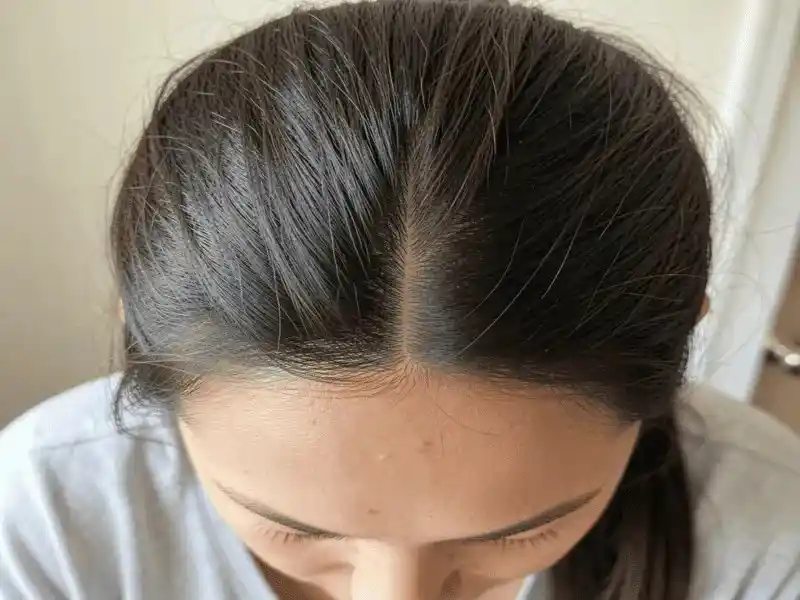
Diffuse Thinning: You’ll notice a wider part line or a smaller ponytail diameter across the entire scalp.
Sudden Shedding: You might see large clumps in the shower, a condition known as telogen effluvium.
Nail Ridges: Brittle or ridged nails often mirror the state of your hair during the “Before” stage.
The “After” Phase: What Real Recovery Looks Like
The thyroid hair loss before and after transformation doesn’t happen overnight. Recovery is a slow, steady climb. Here is what you should look for as your body heals:
Reduced Shedding: The first sign of success isn’t new growth; it’s stopping the loss. You’ll notice fewer strands on your pillow and in the drain.
The “Baby Hair” Frizz: You’ll see short, fine hairs sticking up along your hairline. They might look like frizz, but they are actually new follicles waking up!
Improved Texture: As your hormones stabilize, the new hair coming in will feel softer and stronger than the brittle “before” hair.
Scalp “Grip”: You will notice your hair feels more securely anchored, resisting shedding during brushing or styling.
2026 Recovery Timeline: Month-by-Month Expectation
Patience is your best friend here. Here is the realistic timeline for thyroid hair loss before and after results:
Months 1-2 (The Reset): Your focus is balancing hormones. You might still see shedding as “old,” weak hairs make way for new ones. Your body is prioritizing internal organ repair first.
Months 3-4 (The Stabilization): Shedding slows down significantly. You might notice the scalp feels less “tender” or inflamed. Under the surface, follicles are finally receiving the T3 signal to restart.
Month 6 (The Turning Point): Tiny sprouts of new growth become visible. This is where the “baby hair frizz” becomes undeniable.
Month 12 (The Transformation): Significant volume returns. The difference between your thyroid hair loss before and after photos will be undeniable as the hair shafts reach terminal length and density.
Need a boost during your recovery months?
Expert Tips to Speed Up Your Regrowth
To move from the “before” to the “after” faster, you need a multi-pronged approach:
Optimize Your Ferritin Levels: In 2026, we know that thyroid and iron go hand-in-hand. Your ferritin (stored iron) needs to be at least 70-100 ng/mL for hair to grow.
Check Your Selenium and Zinc: These minerals are vital to convert T4 into the active T3 hormone. Adding Brazil nuts or a zinc supplement can bridge the gap.
Low-Level Laser Therapy (LLLT): Using a medical-grade red light cap for 15 minutes every other day can stimulate the mitochondria in your hair follicles to jumpstart growth.
Top Recommended Device 2026
Medical-Grade LLLT Hair Growth Cap
FDA-cleared technology specifically designed to wake up dormant follicles caused by thyroid imbalances. Use for just 15 minutes a day to see results.
View Current Price on Amazon →
*Prime Eligible | Free Shipping in USA
As an Amazon Associate, I earn from qualifying purchases.
Avoid Harsh Chemicals: While in the fragile “before” stage, avoid high-heat styling and harsh bleaches. Treat your hair like silk.
The Role of Medication: Is Levo Enough?
Many people find that their TSH levels are “normal” on levothyroxine, but their hair is still falling out. If you are stuck in the “before” stage, talk to your doctor about:
T3 Supplementation: Adding liothyronine (Cytomel) helps where T4 alone fails, especially for those with conversion issues.
Biotech Serums: 2026 has seen a rise in peptide-based scalp serums (like Capixyl™ or Procapil®) that support regrowth without the side effects of traditional chemicals.
Essential Post-Pregnancy Tip:
Summary Table: Before vs. After
| Feature | Before (Active Thyroid Issue) | After (Hormonal Balance) |
| Hair Texture | Dry, brittle, straw-like | Soft, shiny, elastic |
| Scalp Visibility | Wide part, visible scalp | Narrow part, denser growth |
| Eyebrows | Thinning at the ends | Full and defined |
| Daily Shedding | 150+ strands | 50-100 strands (Normal) |
FAQs (Frequently Asked Questions)
1. How long does it take to see thyroid hair loss before and after results?
Most people see a decrease in shedding within 2–3 months of stabilizing their levels. A full visual transformation usually takes 6–12 months.
2. Is thyroid hair loss permanent?
No, it is typically temporary. Once the hormonal imbalance is corrected, the follicles return to the growth phase.
3. Why is my hair still falling out after starting levothyroxine?
This is often a “reset” shed where old hairs make way for new growth. It is a normal part of the thyroid hair loss before and after the journey.
4. Can vitamins speed up the recovery?
Yes, specifically ferritin (iron), selenium, and zinc. Maintaining optimal levels can significantly shorten your recovery timeline.
5. How can I tell if my hair loss is thyroid-related?
Look for “diffuse” thinning (all over the head) and the thinning of the outer third of your eyebrows.
6. Will my hair texture ever be the same?
Yes! Once your metabolism is restored, your follicles will produce hair that is healthier and more hydrated.
7. Should I use minoxidil?
Minoxidil provides a temporary boost, but for a permanent thyroid hair loss before-and-after success story, you must treat the hormonal root cause first.
Medical Disclaimer
Disclaimer: The information provided in this article is for educational purposes only and does not constitute medical advice. Always consult with a qualified healthcare professional or endocrinologist before starting new supplements or changing your medication.