Glutathione and Vitamin C Stacking: The Clinical Protocol for Stubborn Melasma (2026)
Glutathione and Vitamin C Stacking: The Clinical Protocol for Stubborn Melasma (2026)
Medical Disclaimer
The details presented in this guide are solely for educational and informational purposes and are not meant to serve as medical advice. While glutathione and vitamin C are generally considered safe, hyperpigmentation can sometimes be a symptom of underlying health conditions. Always consult with a board-certified dermatologist before starting a new clinical skincare protocol, especially if you are pregnant, nursing, or have a history of skin sensitivity. Always perform a patch test before full application.
Introduction
Treating stubborn hyperpigmentation or melasma can feel like hitting a brick wall. You might be using a great Vitamin C serum, but your results have stalled and those deep dark spots won’t budge. This is where antioxidant stacking comes in. By combining Glutathione with Vitamin C, you unlock a powerful duo. While most people see them as separate brighteners, dermatology shows they actually supercharge one another. Here is the science behind why this pair works so well, and exactly how to layer them for clinical-grade results at home.
The Science of the “Redox Cycle”: Why One Needs the Other
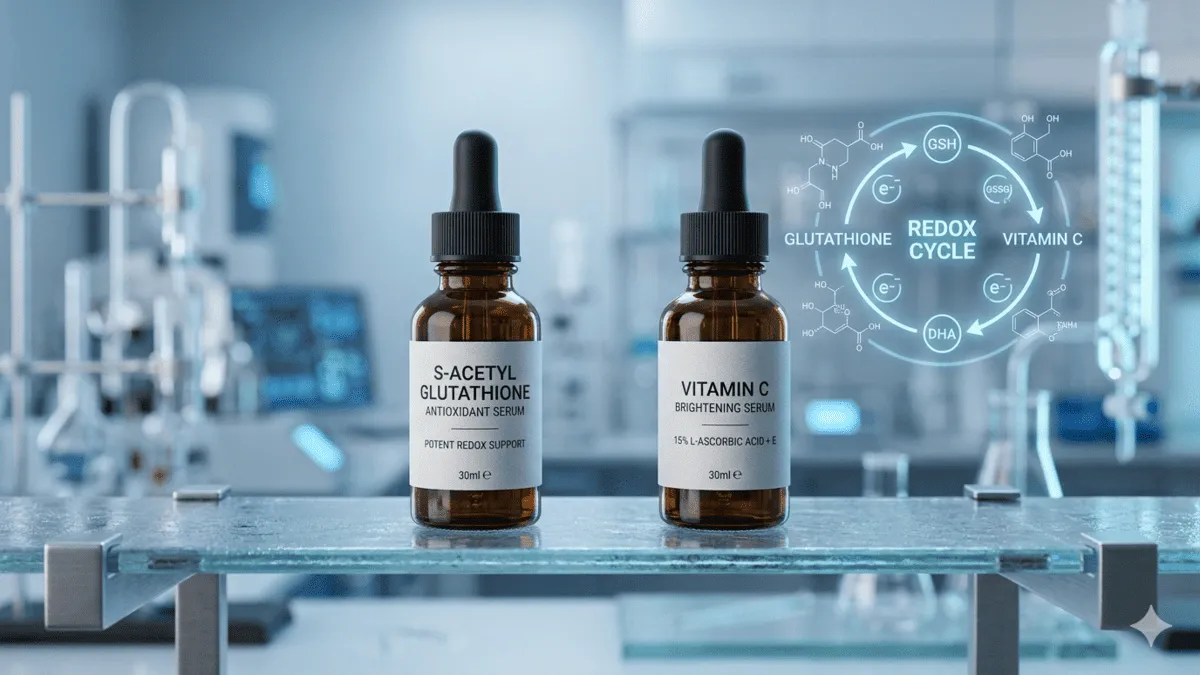
Most skincare guides tell you that Glutathione and Vitamin C are both antioxidants. What they don’t tell you is that they work in a continuous loop called the Redox Cycle. In clinical dermatology, this is known as the synergistic antioxidant network.
The Synergistic Electron Exchange
To understand Glutathione and Vitamin C stacking, you must understand how electrons flow. Every time your skin is exposed to UV rays or pollution, free radicals are formed. These molecules are unstable because they are “missing” an electron.
Vitamin C (The Defender): When Vitamin C neutralizes a free radical on your skin, it “donates” its own electron to stabilize the radical. In doing so, the Vitamin C itself becomes “oxidized” and inactive—meaning it can no longer brighten your skin or boost collagen.
Glutathione (The Recharger): This is where Glutathione and Vitamin C stacking become essential. Glutathione acts as a secondary electron donor. It “recharges” the oxidized Vitamin C, converting it back into its active form (L-ascorbic acid).
The Result: Stacking them ensures that your Vitamin C stays stable and active on your skin for hours longer than if used alone.
Preventing Pro-Oxidant Damage
One of the hidden risks of using a high-concentration Vitamin C serum alone is the “pro-oxidant” effect. When Vitamin C becomes oxidized without a partner like Glutathione to recharge it, it can potentially cause more harm than good to the skin cells. By implementing a Glutathione and Vitamin C stacking protocol, you create a safety net that prevents the Vitamin C from becoming a pro-oxidant, ensuring only the brightening benefits reach your dermis.

S-Acetyl Glutathione + Vitamin C Professional Serum
Experience the “Redox Cycle” with this clinical-grade 2026 formula. Specifically designed for stubborn melasma and the Pheomelanin switch.
Enhancing Skin Surface Stability
Vitamin C is notoriously unstable and prone to rapid oxidation when exposed to light and air. Clinical research suggests that the presence of a thiol-based antioxidant like Glutathione improves the overall stability of the formula. This means that Glutathione and Vitamin C stacking not only helps the ingredients work better inside the skin but also keeps them fresh and potent on the surface for a longer duration.
Glutathione vs. Vitamin C: Key Differences in 2026 Formulations
While both ingredients are celebrated for their brightening properties, they operate through distinct biochemical pathways. Understanding these differences is crucial for Glutathione and Vitamin C stacking, as it allows you to target pigmentation at two different stages of melanogenesis.
Comparison Table: 2026 Clinical Specifications
| Feature | Vitamin C (L-Ascorbic Acid) | S-Acetyl Glutathione |
| Primary Action | Tyrosinase Inhibition | Pheomelanin Switch (Dark to Light) |
| Best For | UV Damage & Instant Glow | Deep Hormonal Pigmentation |
| Stability | Low (Turns brown easily) | High (Very stable molecule) |
| pH Level | Acidic (3.0 – 3.5) | Neutral (5.5 – 6.0) |
Tyrosinase Inhibition vs. The “Pheomelanin Switch”
The most significant difference in Glutathione and Vitamin C stacking lies in how they handle melanin. Vitamin C acts primarily as a Tyrosinase Inhibitor. Tyrosinase is the enzyme responsible for the first step of melanin production; by blocking it, Vitamin C prevents the pigment from forming in the first place.
On the other hand, S-Acetyl Glutathione goes a step further by influencing the type of melanin produced. It facilitates a “switch” in the melanocytes, shifting production from Eumelanin (the dark brown/black pigment found in melasma) to Pheomelanin (a lighter, yellow/red pigment). This results in a more natural, radiant skin tone rather than just fading existing spots.
Stability and Molecular Integrity
In 2026, the focus has shifted from standard L-Ascorbic Acid to more stable delivery systems. However, pure Vitamin C remains notoriously unstable and sensitive to oxidation. Glutathione and Vitamin C stacking provides a solution here: Glutathione acts as a stabilizer. While Vitamin C typically requires a very low (acidic) pH to penetrate the skin—which can often cause irritation—S-Acetyl Glutathione is stable at a neutral pH. This makes the combination much safer for those with a compromised skin barrier or sensitive skin.
Targeted Concerns: UV Damage vs. Hormonal Pigmentation
When selecting your products for Glutathione and Vitamin C stacking, consider the origin of your pigmentation.
Vitamin C is the gold standard for treating “Solar Lentigines” (sun spots) and providing immediate surface radiance due to its mild exfoliating acidic nature.
S-Acetyl Glutathione is superior for deep-seated, “recalcitrant” issues like melasma or Post-Inflammatory Hyperpigmentation (PIH), as it works at a deeper cellular level to regulate pigment quality.
The “Pheomelanin Switch”: How Glutathione Changes Your Skin Tone
Glutathione and vitamin C stacking provide a sophisticated rerouting of your skin’s biological pigment production, in contrast to conventional brighteners that merely erase existing spots. Glutathione is unique because it doesn’t just “stop” pigment; it redirects it at the cellular level.
Understanding the Melanin Spectrum
To understand how Glutathione and Vitamin C stacking transform your complexion, you must first understand that our skin produces two distinct types of melanin:
Eumelanin: This pigment is either black or dark brown. It is primarily responsible for the visible “spots,” melasma patches, and deep hyperpigmentation that many users find difficult to treat.
Pheomelanin: This is a lighter, red or yellowish pigment. It is associated with a natural, bright, and fair glow rather than the muddy appearance of localized hyperpigmentation.
The Biochemical Pivot: Redefining “Whitening”
Clinical research conducted in 2026 indicates that high-purity topical Glutathione—particularly when complemented by the Redox Cycle of Vitamin C—promotes the melanocytes to modify their production. Through a process often called the “Pheomelanin Switch,” Glutathione increases the intracellular levels of cysteine.
When cysteine levels are high, the enzyme tyrosinase (which Vitamin C is already busy inhibiting) is forced to produce Pheomelanin instead of Eumelanin. Instead of only fading specific areas, this results in a complexion that is generally brighter and more radiant.
Why Stacking Accelerates the Switch
While Glutathione handles the “switch,” Vitamin C acts as the catalyst that keeps the environment stable. Without Glutathione and Vitamin C stacking, the melanocytes may struggle to maintain this lighter pigment production, especially when triggered by the harsh UV exposure common in the USA market. By using both, you are essentially telling your skin to stop making “dark” pigment and start making “light” pigment simultaneously.
The 2026 Stacking Protocol: Step-by-Step Layering
To avoid irritation and maximize the absorption of these potent antioxidants, follow this structured routine. This approach ensures that Glutathione and Vitamin C stacking works in harmony with your skin’s natural circadian rhythm.
AM: The Protective Shield
The morning goal of Glutathione and Vitamin C stacking is to neutralize environmental aggression.
Cleanse: Use a gentle, pH-balanced cleanser to prepare the skin surface without stripping the acid mantle.
Vitamin C Serum: Apply a 10-15% L-ascorbic acid serum. This concentration provides a powerful first line of defense against UV-induced free radicals and pollution common in the USA market.
Moisturize: Apply a light, non-comedogenic moisturizer to “seal” the Vitamin C and prevent transepidermal water loss.
SPF 50 (Crucial): This step is non-negotiable. Without a high-level SPF, the “Pheomelanin Switch” initiated by Glutathione and Vitamin C stacking will be reversed by immediate UV damage.
PM: The Repair & Switch
The evening goal is deep-seated pigment correction and cellular “recharging.”
Double Cleanse: Use an oil-based cleanser followed by a water-based one to completely remove pollutants, makeup, and waterproof SPF.
Glutathione Serum/Cream: This is the core of your Glutathione and Vitamin C stacking routine. Look for S-Acetyl Glutathione or Liposomal versions, as these 2026 formulations offer superior penetration into the dermis compared to standard reduced glutathione.
Barrier Repair (Optional): If you have sensitive skin or are currently dealing with a compromised barrier, follow with a ceramide-rich cream to support the skin’s structural integrity while the active ingredients work overnight.
What to Look for in Amazon Products (USA Guide)
It’s important to examine the formulation’s clinical profile and look past marketing claims when purchasing these ingredients on Amazon. For the best results in 2026, prioritize these three non-negotiable features:
1. Liposomal or S-Acetyl Delivery Systems
The standard “Reduced Glutathione” molecule is often too large and unstable to penetrate the skin’s lipid barrier. When implementing a glutathione and vitamin C stacking routine, look specifically for the following:
Liposomal Glutathione: Encapsulates the ingredient in a fat-soluble bubble to ensure it reaches the deeper dermis.
S-Acetyl Glutathione: A highly stable derivative that is more effective at triggering the “pheomelanin switch” than generic versions.
2. Airless Pump Packaging
Both glutathione and vitamin C are highly sensitive to environmental exposure.
Avoid Dropper Bottles: Every time you open a dropper bottle, you introduce oxygen, leading to rapid oxidation (turning your serum brown and ineffective).
Prioritize Airless Pumps: This medical-grade packaging prevents air from entering the container, ensuring that your glutathione and vitamin C stacking protocol remains potent from the first drop to the last.
3. Clinical-Grade Percentages
Steer clear of products that obscure their active ingredients within “proprietary blends.” To achieve effective stacking of glutathione and vitamin C, the concentrations need to be sufficiently high to induce a biological change.
S-Acetyl Glutathione + Vitamin C Professional Serum
Experience the “Redox Cycle” with this clinical-grade 2026 formula. Specifically designed for stubborn melasma and the Pheomelanin switch.
Topical Glutathione: Look for a minimum of 2% concentration (ideally in S-acetyl form).
Vitamin C (L-Ascorbic Acid): Prioritize formulas between 10% and 15%. Anything lower may be ineffective for melasma, while anything higher can cause unnecessary irritation for those with sensitive skin.
Frequently Asked Questions (FAQ)
Q1: Can I mix vitamin C and glutathione in my hand before applying?
A: It is better to layer them or use a pre-formulated “stack” product. Vitamin C (L-ascorbic acid) is highly acidic, and mixing it manually can destabilize the neutral pH of glutathione. To maintain the molecular integrity of both, apply vitamin C first, let it absorb for 60 seconds, and then apply your glutathione treatment.
Q2: How long until I see visible results from stacking?
A: While Vitamin C provides a surface “glow” in as little as 2 weeks, the cellular “pheomelanin switch” from glutathione is a biological process that takes time. Expect to see significant fading of stubborn melasma within 8 to 12 weeks of consistent nightly use.
Q3: Can I use this stacking protocol with retinol?
A: Yes, but with caution. You can use your vitamin C/glutathione stack in the morning and retinol at night. However, if your skin is sensitive, do not layer retinol directly with an acidic vitamin C serum, as this can lead to barrier irritation.
Q4: Is this protocol safe for all skin tones?
A: Absolutely. Unlike harsh bleaching agents like hydroquinone, glutathione and vitamin C stacking is safe for all Fitzpatrick skin types. It works by regulating pigment quality rather than killing melanocytes, making it an ideal long-term solution for darker skin tones prone to PIH.
Q5: Does oral glutathione work as well as topical stacking?
A: While oral supplements can raise systemic antioxidant levels, topical application is superior for “recalcitrant melasma” because it delivers a concentrated dose directly to the affected melanocytes. For the best results in 2026, many clinicians suggest “Internal + External” stacking.
Conclusion: The Future of Pigment Correction
Adding glutathione to your skincare routine makes sense if you’ve had trouble with dark spots that won’t go away with only vitamin C. By leveraging the Redox Cycle, you aren’t just adding another product—you are making your entire routine twice as effective. In 2026, the secret to a clear complexion isn’t more ingredients; it’s smarter stacking.