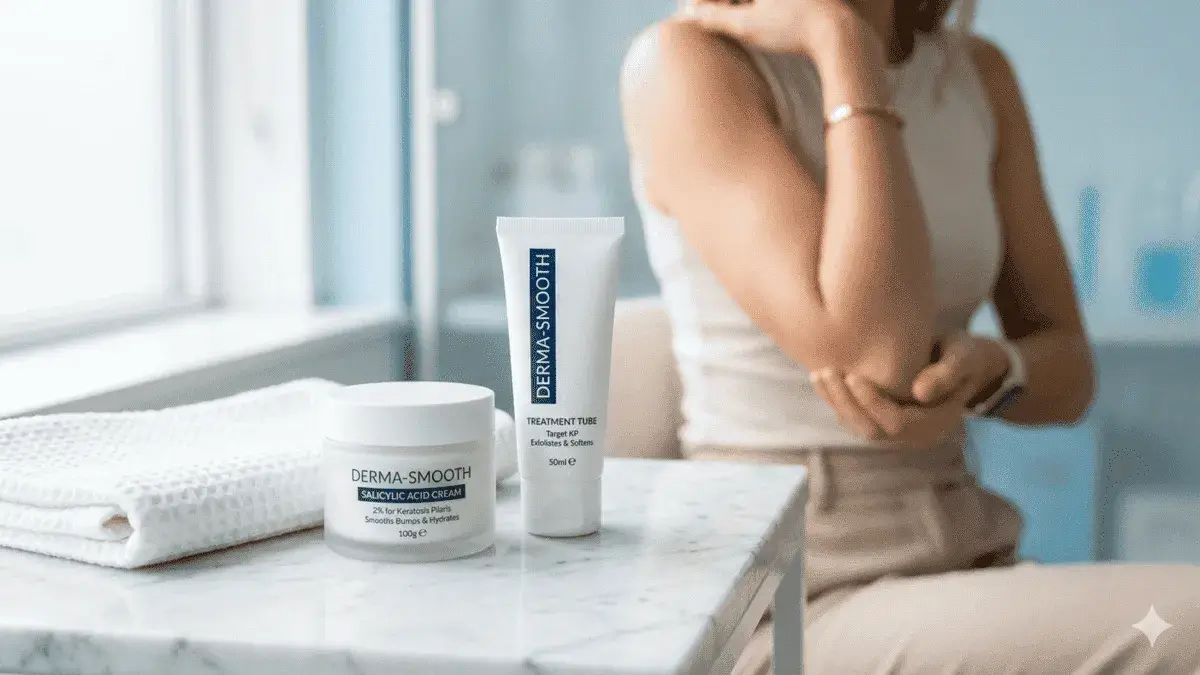
Best Salicylic Acid Cream for Keratosis Pilaris: Does it Work? (2026 Clinical Guide)
The Ultimate Clinical Guide: Salicylic Acid Cream for Keratosis Pilaris (2026)
This 2026 clinical update looks at how Salicylic Acid (BHA) helps with Keratosis Pilaris (KP), a common, harmless but annoying skin issue. The report digs into how the acid works on a molecular level and compares its effectiveness to other treatments like alpha-hydroxy acids and urea. Plus, it gives a guide for long-term use from a USA-focused dermatology view.
If you’re dealing with tiny, rough bumps that make your skin feel like “chicken skin,” know you’re not the only one. Doctors call it Keratosis Pilaris (KP), and it’s pretty common. Roughly 40% of adults and between 50 and 80% of teens in the USA have it. Although it’s nothing serious health-wise, folks want it treated because it can be itchy and red.
KP happens due to an excess of keratin in your skin. When you get too much keratin, it clogs up the pores and creates a plug right in the hair follicle. That’s what causes the rough, bumpy texture.
Doctors tend to use salicylic acid cream since it’s lipid-soluble. This means it can really dig into those oily follicles and break down that stubborn buildup of keratin. Other creams just can’t do what salicylic acid does here. In a detailed 2026 guide, experts spell out why this acid continues to top the list for treating KP.
2. The Molecular Mechanism: How Salicylic Acid Cream for Keratosis Pilaris Works
To understand why salicylic acid cream for keratosis pilaris is the premier choice for clinicians, we must look at the “desmosomal” level of the skin.
A. Histology and Deep Pore Penetration
At the microscopic level, KP is characterized by follicular hyperkeratinization.
This means the skin’s natural shedding process (desquamation) has malfunctioned within the follicular funnel. To learn more about the specific layers involved, see our guide on Histology for Healthy Skin.
Salicylic acid cream for keratosis pilaris works through a process called “acid-catalyzed hydrolysis” of the intercellular cement. It targets the desmosomes—the protein bridges that hold dead skin cells (corneocytes) together. By disrupting these bridges, the BHA allows the compact keratin plug to soften, break apart, and eventually wash away during your daily cleansing routine. Because it is lipophilic, it travels down the sebaceous gland’s path, ensuring that the treatment reaches the root of the plug, not just the surface.
B. Anti-Inflammatory and Antimicrobial Benefits
One of the biggest challenges with KP is “perifollicular erythema”—the red ring around each bump. Salicylic acid is a derivative of salicin (chemically related to aspirin). This gives salicylic acid cream for keratosis pilaris intrinsic anti-inflammatory properties. It inhibits the synthesis of prostaglandins, which are the chemical messengers responsible for pain and redness. This makes it significantly more effective than urea or AHA for patients suffering from “red KP” or inflammatory variants.
C. Regulation of Sebum and Debris
While KP isn’t caused by oil (like acne is), sebum acts as the “glue” that keeps the keratin plug trapped. By dissolving these lipids, BHA creates a cleaner follicular environment, preventing the recurrence of the plug.
3. Choosing Your Active: Salicylic Acid Cream for Keratosis Pilaris vs. Urea?
In the world of evidence-based skincare, the debate often centers on whether to use a BHA or a humectant like urea.
The Case for Salicylic Acid: If your skin feels “congested,” looks red, or the bumps are hard and “pimple-like,” BHA is superior. It is a targeted strike on the follicular blockage itself.
The Case for Urea: If your skin is extremely dry, flaky, or “fish-scale”-like (ichthyosis), urea provides better hydration.
Clinical Recommendation: Most 2026 dermatological protocols suggest a synergistic approach. You use a salicylic acid cream for keratosis pilaris at night to exfoliate and a high-percentage urea lotion in the morning to hydrate. For a deep-dive molecular comparison of these two actives, refer to our comprehensive guide: Urea vs. Salicylic Acid for Keratosis Pilaris.
4. Advanced Formulations: Top 5 USA Recommendations (2026)
Choosing the right vehicle (cream, lotion, or serum) is critical. Here are the top evidence-based recommendations currently leading the USA market:


 Stubborn KP that needs dual-acid (Salicylic + Glycolic) power.
1. CeraVe SA Cream for Rough & Bumpy Skin
This is often the first recommendation from US dermatologists. It utilizes MVE technology, which releases salicylic acid slowly over 24 hours. This “slow-drip” method ensures that the skin barrier isn’t overwhelmed, making it perfect for long-term maintenance.
2. Paula’s Choice 2% BHA Body Treatment
For those with sensitive skin, this formulation is a gold standard. It is pH-optimized (between 3.2 and 3.8), which is the “sweet spot” for BHA efficacy. It also contains green tea and chamomile to further soothe the skin.
3. La Roche-Posay Effaclar Clarifying Solution
If your KP is stubborn and doesn’t respond to BHA alone, this dual-acid system (salicylic + glycolic) provides a “top-down and bottom-up” exfoliation.
4. Neutrogena Body Clear (Salicylic Acid Formula)
A budget-friendly pharmacy option that is excellent for prevention. It is lightweight and doesn’t leave a greasy residue, making it ideal for use on the back or thighs.
5. The Ordinary Salicylic Acid 2% Solution
A minimalist approach for spot-treating specific areas like the back of the arms. It is highly concentrated and should be used with caution on large surface areas.
5. The Clinical Protocol: Applying Salicylic Acid Cream for Keratosis Pilaris
Applying the cream correctly is just as important as the ingredients themselves. Follow this 3-phase clinical protocol for maximum results:
Phase 1: The Acclimatization Period
Do not start using BHA twice a day immediately.
Weeks 1–2: Apply your salicylic acid cream for keratosis pilaris every other night.
Weeks 3–4: If no redness or peeling occurs, move to once-daily application in the evening.
Phase 2: The “Damp Skin” Absorption Optimization
Clinical studies show that slightly damp skin is more permeable. After showering with lukewarm water, pat your skin with a towel so it is “dewy” but not dripping. Apply the cream within 3 minutes. This traps moisture and allows the BHA to penetrate deeper into the follicle.
Phase 3: Barrier Fortification
Exfoliation, by definition, thins the outer layer of dead skin. Your skin is more susceptible to UV damage as a result.
Sun Protection: You must use a broad-spectrum SPF 30+ on treated areas.
Ceramide Support: Ensure your routine includes ceramides to prevent “Transepidermal Water Loss” (TEWL).
6. Troubleshooting: Why Your KP Isn’t Clearing
If you have used salicylic acid cream for keratosis pilaris for 6 weeks and see no change, check these factors:
1. The pH of the Product
Salicylic acid requires an acidic environment to work. If the product’s pH is above 4.0, the acid becomes “neutralized” and loses its keratolytic power. Stick to clinical brands that disclose their pH levels.
2. Water Temperature Sabotage
Hot water strips the natural oils from your skin, causing the body to produce more keratin as a protective response. This effectively “re-plugs” the pores you just cleared. Switch to lukewarm water immediately.
3. Systemic Influences: The Cortisol Connection
Recent 2026 research has highlighted the link between stress and skin barrier function. High levels of cortisol skin can trigger inflammatory pathways that make KP look angrier and redder. Managing internal stress is often the missing piece of the puzzle.
4. Mechanical Friction
Wearing tight leggings or “skinny” jeans causes friction against the hair follicles, leading to “friction-induced hyperkeratosis.” Opt for breathable, loose cotton fabrics during your treatment phase.
7. Conclusion: The Verdict on Salicylic Acid Cream for Keratosis Pilaris
There is no “permanent cure” for keratosis pilaris because it is often genetic. However, management is entirely possible. Salicylic acid cream for keratosis pilaris remains the premier clinical choice because it addresses the three pillars of the condition: follicular plugging, inflammation, and oil-trapped debris.
By combining a high-quality BHA formulation with consistent application and sun protection, you can achieve a 70-90% improvement in skin texture within one to two skin cycles (approx. 8 weeks).
FAQ (Frequently Asked Questions)
How long does it take for salicylic acid cream for keratosis pilaris to work? Most patients see a textural change in 2-4 weeks, but complete smoothing of red “dots” can take 8-12 weeks of consistent use.
Can I use it on “strawberry legs”? Absolutely. Salicylic acid cream for keratosis pilaris is the gold standard for “strawberry legs” (open comedones). For a full protocol on this specific area, visit our Strawberry Skin Treatment guide.
Can I use a physical scrub with salicylic acid? We advise against aggressive physical scrubbing. BHA is a chemical exfoliant that does the work for you. Scrubbing can cause micro-tears, leading to more inflammation and darker spots (PIH).
What if my skin starts peeling? Peeling is a sign of over-exfoliation. Reduce your application to twice a week and increase your use of a basic ceramide moisturizer until the barrier heals.
Is it safe for pregnant women? While low-concentration BHA in small areas is usually okay, we recommend switching to lactic acid or urea during pregnancy. Always consult your OBGYN first.
Disclaimer
This manual is solely meant to be used for educational and informational purposes. It is not a replacement for expert medical advice and represents clinical research as of 2026. Before attempting new active substances, always do a patch test.