7 Powerful Reasons Polynucleotides Are Better Than Hyaluronic Acid for DNA Repair
Polynucleotides: The Complete Guide to DNA-Based Skin Regeneration in 2026
Disclaimer
The information contained in Nagash Health, by Sarah Reed (Skincare Researcher & Wellness Consultant), is intended to be used for educational purposes only. Although great care has been taken to assure the accuracy and completeness of the information presented herein, no information contained on this website is intended to substitute for medical consultation or treatment. Always get advice from a dermatologist or other medical expert.
Introduction
The future of skincare is changing in 2026. Regenerative aesthetics is taking over. For years, the industry focused only on temporary fixes. Products like Hyaluronic Acid just added volume to mask aging. However, patients now want something deeper. They want to treat skin concerns at the root. This is where Polynucleotides come in. This cutting-edge technology uses DNA fragments to repair and renew the skin naturally.
At a Glance: Why DNA Repair Wins
If you’re wondering why the industry is shifting, here are the 7 reasons we explore in this guide:
Cellular Instruction: Unlike HA, it tells cells to regenerate.
DNA Salvage Pathway: Provides the literal building blocks for new skin.
Fibroblast “Wake-up”: Reverses cellular laziness.
ECM Remodeling: Clears out “cellular junk.”
No Puffiness: Ideal for the delicate under-eye area.
Bio-compatibility: Perfectly mimics human DNA.
Lasting Density: Builds real skin thickness, not just fake volume.
What Are Polynucleotides?
In molecular terms, polynucleotides are long strands made up of nucleotide molecules. In the field of medical skincare, polynucleotides refer to very pure DNA derivatives called “biostimulators.” While fillers work by adding volume to your skin, Polynucleotides are smart molecules that work biologically to heal damaged skin.
The Source: Why Use DNA from Salmon (PDRN)?
The most potent Polynucleotides for skin rejuvenation usually originate from salmon sperm DNA, which is commonly called Polydeoxyribonucleotide (PDRN) in medical literature. Why do doctors choose salmon DNA? According to scientific research, salmon DNA has high compatibility with human DNA. After the fractions have been isolated from the material and applied to human skin, they do not trigger the body’s defense mechanisms against foreign “intruders.” Instead, the skin perceives these fractions as friendly materials that can be used to boost the renewal rate.
The Biological Mechanism (How It Works)
To get a better idea of how powerful Polynucleotides are, you need to dig deeper into their biological mechanism of action. Their main purpose is not hydration but alteration of skin cell activity.
Activation of Fibroblasts: Signals for a Younger Age
One of the crucial roles played by Polynucleotides in anti-aging treatment is their ability to activate fibroblasts. As you may recall from biology classes, fibroblasts are the “engines” of the skin, which produce Type I Collagen, elastin, and hyaluronic acid in the skin. As we age, our fibroblasts become inactive or “lazy.”
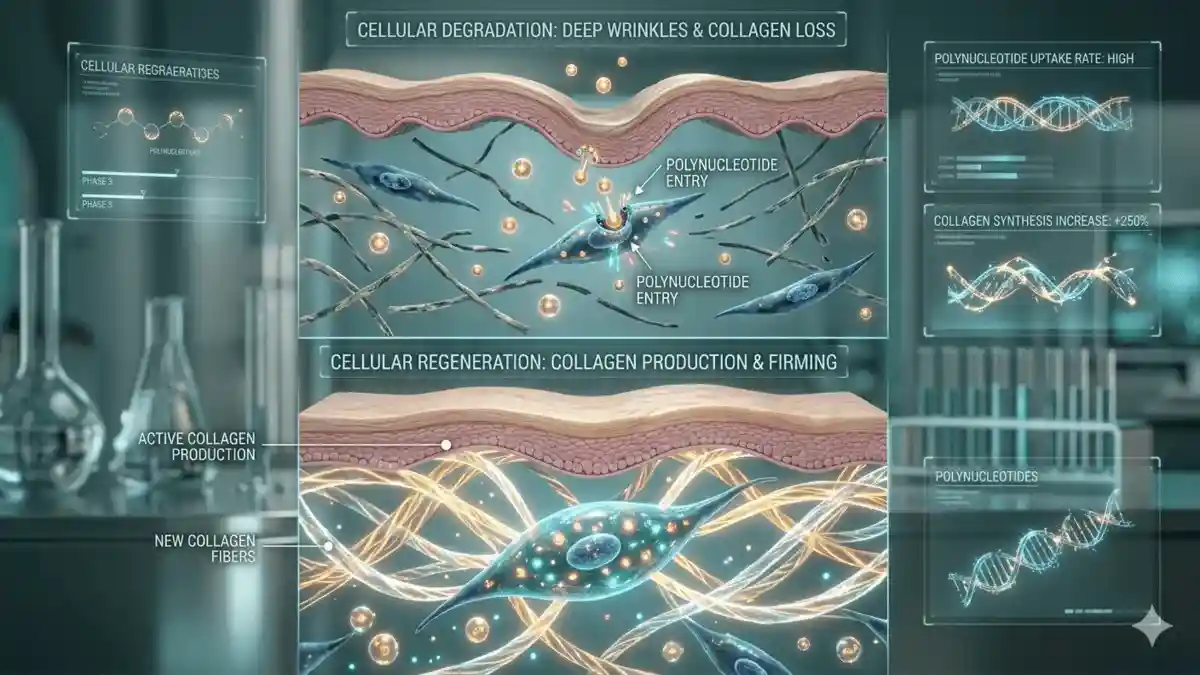
In essence, polynucleotides are signals telling the cells to start producing collagen and elastin again. As a result, your skin becomes stronger and thicker.
Nucleotides: Building Blocks for DNA Synthesis
Polynucleotides can be considered precursors of nucleotides used for DNA synthesis during cell division. Once Polynucleotides undergo enzymatic hydrolysis in the skin, they release individual nucleotides. These nucleotides can be used as building blocks for synthesizing DNA when your skin cells divide. The process of using recycled nucleotides as the basis for DNA synthesis is called the salvage pathway.
ECM Remodeling
Lastly, Polynucleotides assist in remodeling the ECM. This is the scaffolding that keeps your skin cells bound. In addition, by improving the quality of the ECM, Polynucleotides will remove the unhealthy matrix (“cellular junk”) and replace it with a healthy hydrated one. The result is smooth skin texture and reduction of fine lines. This cannot be accomplished with the help of a basic moisturizer.
Polynucleotides vs. Traditional Injectables
One question I am regularly asked as a Skincare Researcher is whether or not Polynucleotides “are just another filler.” Providing reliable advice means knowing when to draw a line between restoring a volume deficit and cell regeneration therapy.
Polynucleotides vs. Dermal Fillers
A dermal filler usually consists of cross-linked HA. It functions as a “filler” and provides an immediate lift through the action of sitting beneath the skin. Dermal fillers do not enhance the overall quality of the skin but simply fill in the volume gaps. Polynucleotides function as biostimulators, meaning that they stimulate your body to produce collagen and elastin instead of providing an artificial volume.
Difference between Polynucleotides and Skin Boosters
Even though skin boosters (Profhilo and non-cross-linked hyaluronic acid) provide an intensive skin glow, they are usually temporary. Polynucleotides have a much greater effect—while they also provide a certain degree of hydration, their primary purpose is DNA repair and stimulation of fibroblasts. Polynucleotides will be more beneficial in the long run because they physically improve the thickness of the dermis.
The Synergy Treatment Approach
Today, in 2026, we can obtain impressive results with the synergistic combination of Polynucleotides with other evidence-based treatments. For example:
Synergy with Microneedling: Applying polynucleotide-infused serums following a microneedling session leverages the newly created dermal pathways. This allows the DNA-based fractions to reach deeper tissue layers more efficiently, drastically shortening recovery time and boosting structural repair.
By utilizing Photobiomodulation through specialized LED devices, you can amplify mitochondrial ATP levels. This surge in cellular energy acts as a catalyst, significantly optimizing the regenerative signaling of polynucleotides for superior collagen synthesis.
Clinical Applications
There is no doubt that Polynucleotides are extremely versatile treatment agents, which fits our clinical approach perfectly—especially because of its practical side.
Under-Eye Rejuvenation: “Holy Grail” of Peri-Ocular Area
The eye area is the most fragile and often the first to reveal signs of aging. We already covered polynucleotides for the under-eye treatment but want to stress the key reasons for their efficacy in this area. They help lighten dark circles by thickening the skin (making underlying veins less visible) and addressing the “crepey” skin texture issue.
Skin Barrier Repair and Sensitization
Inflammation and burnout of the skin barrier layer are prevalent problems in today’s polluted environment. By leveraging their potent soothing properties, polynucleotides play a critical role in restoring skin health. They effectively diminish erythema and reinforce the dermal barrier, enhancing its resilience against external aggressors. They are perfect for usage in cases of rosacea or following extensive exfoliation or retinoids since they decrease the skin’s immune cells’ excessive activity.
Targeted Treatments: Acne Scar and “Tech Neck”
Polynucleotides’ remodeling of the extracellular matrix (ECM) helps to smooth out atrophic acne scars.
Venus Ring Targeting: During digital engagement, the head’s constant downward inclination applies mechanical force that permanently leaves “necklace lines” on the skin.
By enhancing the density of the dermal matrix, polynucleotides provide a lifting effect that smooths out creases resulting from poor posture, significantly improving skin texture. Polynucleotides act as a biological lifting agent, restoring dermal density and smoothing these ‘tech-driven’ folds by restructuring the skin’s internal scaffolding.
Treatment Experience and Safety
As a wellness consultant, I am aware that understanding the “how” and “how safe” of a treatment is just as important as understanding its scientific foundation. Patients should be completely informed about the operation in a clinical setting.
Application Methods: Topical Versus Injectable
In order to ensure that DNA fractions reach the dermis, where fibroblasts are found, polynucleotides will be administered using micro-injections (mesotherapy). It is worth noting that 2026 has seen the development of highly concentrated topical serums and post-treatment gels. While non-invasive topical formulations serve as a cost-effective and accessible entry point, their regenerative potential is significantly amplified when integrated into a multimodal strategy alongside professional interventions like microneedling.

Medicube PDRN Pink Peptide Serum
A high-performance serum featuring PDRN (Salmon DNA) to visibly brighten, firm, and repair the skin barrier. Perfect for post-treatment care.
Safety and Possible Side Effects
Because the polynucleotides are completely compatible with human DNA, they can be considered quite safe. An allergic reaction is highly improbable because of its great purity. The most frequent side effects, such as swelling, redness, or bruises on the injection site, are related to the treatment itself and go away in 24 to 48 hours. However, it is advised that those who have a serious allergy to any seafood pay attention and seek professional advice.
Clinical Studies 2026: The Final Verdict
The cumulative effects of polynucleotides were demonstrated in the most recent research conducted in 2026. Unlike fillers, which eventually go away, bioremodeling caused by DNA regeneration alters the patient’s skin structure irreversibly. Thus, patients need several procedures (usually three or four) to observe their regenerative effects and enjoy them during the following months.
How to Integrate Into Your Skincare Routine
To get dermatologically proven results on a practical budget, one must learn to integrate professional treatments effectively with their routine.
Can You See Results on Your Own?
Whereas injectables deliver the best effect from this treatment, a “homemade” version based on polynucleotides is gaining popularity as a means of maintaining your results. Seek products that contain PDRN or sodium DNA. Integrating these DNA-derived nutrients is essential for revitalizing cellular powerhouses (Article #119), effectively paving the way for a resilient and ultra-luminous skin finish (Article #123) that radiates health from the inside out
Combining with Other Active Ingredients
Polynucleotides are considered very friendly and easily combinable ingredients:
With Vitamin C: Choose an effective and inexpensive vitamin C, wear it during the day, and rely on polynucleotides to repair DNA overnight.
With Retinoids: As the latter helps to strengthen your skin barrier, polynucleotides can help you tolerate more potent formulas of retinoids.
Strategic Investment in Skin Health: Rather than accumulating multiple marketing-heavy formulas, optimize your budget by prioritizing a single, high-potency DNA regeneration serum paired with a clinical-grade barrier recovery cream. This targeted approach ensures you are investing in cellular repair rather than redundant, over-hyped products.
Conclusion : The Future of Skincare
Looking ahead to the rest of 2026, it is clear that we are living in the age of skin regeneration. The introduction of polynucleotides has completely redefined how skin care works since it focuses more on regeneration rather than covering up skin aging problems.
Our cells are now being trained to function efficiently for us with the aid of purified salmon DNA. Purified salmon DNA makes it simple to combine science and nature, and consumers stand to gain a great deal by having better skin that is resistant to the stresses of the modern world. At Nagash Health, our job is to assist you understand all the latest developments so you can improve the health of your skin.
Frequently Asked Questions (FAQ)
Q1. What number of polynucleotide treatments will provide the best result?
It is recommended that you complete a course of 3-4 treatments, performed every three weeks. You will feel radiant right away, but the most significant changes in the tissue structure happen 3 months after the last procedure.
Q2. Is the DNA utilized by Polynucleotides safe for humans?
Indeed. The PDRN that we use is carefully processed to remove any possible allergens (proteins). Since salmon DNA is nearly identical to our genetic code, our body readily recognizes it.
Q3. Am I eligible for polynucleotide treatment if my skin is prone to breakouts?
Yes, you can. Polynucleotides don’t trigger acne breakouts as well as possess anti-inflammatory properties. They are excellent for post-acne care.
Q4. Are there any skin products I should stay away from after polynucleotide treatment?
In the first 24-48 hours after receiving Polynucleotides at our clinic, you should abstain from any harsh exfoliation, especially chemical ones like high-strength acids (AHAs/BHAs).
Q5. How does this compare to a “vampire facial” (PRP)?
Both are regenerative, but Polynucleotides are standardized compared to PRP (Platelet Rich Plasma). The quality of PRP is dependent on the quality of your blood, while the Polynucleotides will consistently deliver a high concentration of DNA fractions.